
India's menswear market reached USD 21.9 billion in 2025, and it is growing faster online than any other apparel category in Tier 2 cities. Yet most Indian menswear brands publish product images that underperform: flat lays where Myntra requires model shots, ghost mannequins where the platform demands full-length standing presentation, and catalog-style packshots where the buyer is trying to visualise fit, movement, and occasion. The visual problem in men's fashion is specific, solvable, and, with AI, solvable at a cost that works for every brand size.
TL;DR
- Menswear needs on-model images to sell, but male-model shoots are expensive and hard to source in India.
- Myntra and most marketplaces mandate gender-matched, full-length model shots, so flat lays and ghost mannequins get rejected or suppressed.
- AI menswear product photography generates on-model, ghost-mannequin, and lifestyle shots from a single source photo.
- Festive and wedding-season context shots are the highest-value AI use case for Indian ethnic wear.
- AI drops per-image cost to a fraction of a traditional shoot while keeping the whole catalog visually consistent.
Key definition: Menswear product photography using AI is the process of turning a plain source photo of a garment (shot on a mannequin or hanger) into marketplace-ready images, on-model, ghost-mannequin, or lifestyle, using AI generation instead of booking a male model, photographer, and studio.
The Men's Fashion Visual Problem: Why Menswear Is Harder Than Womenswear
Menswear product photography has a structural problem that womenswear does not share in the same way. Understand this problem clearly and the AI solution makes immediate sense.
Menswear is built to be worn, but most Indian brands cannot afford to show it that way
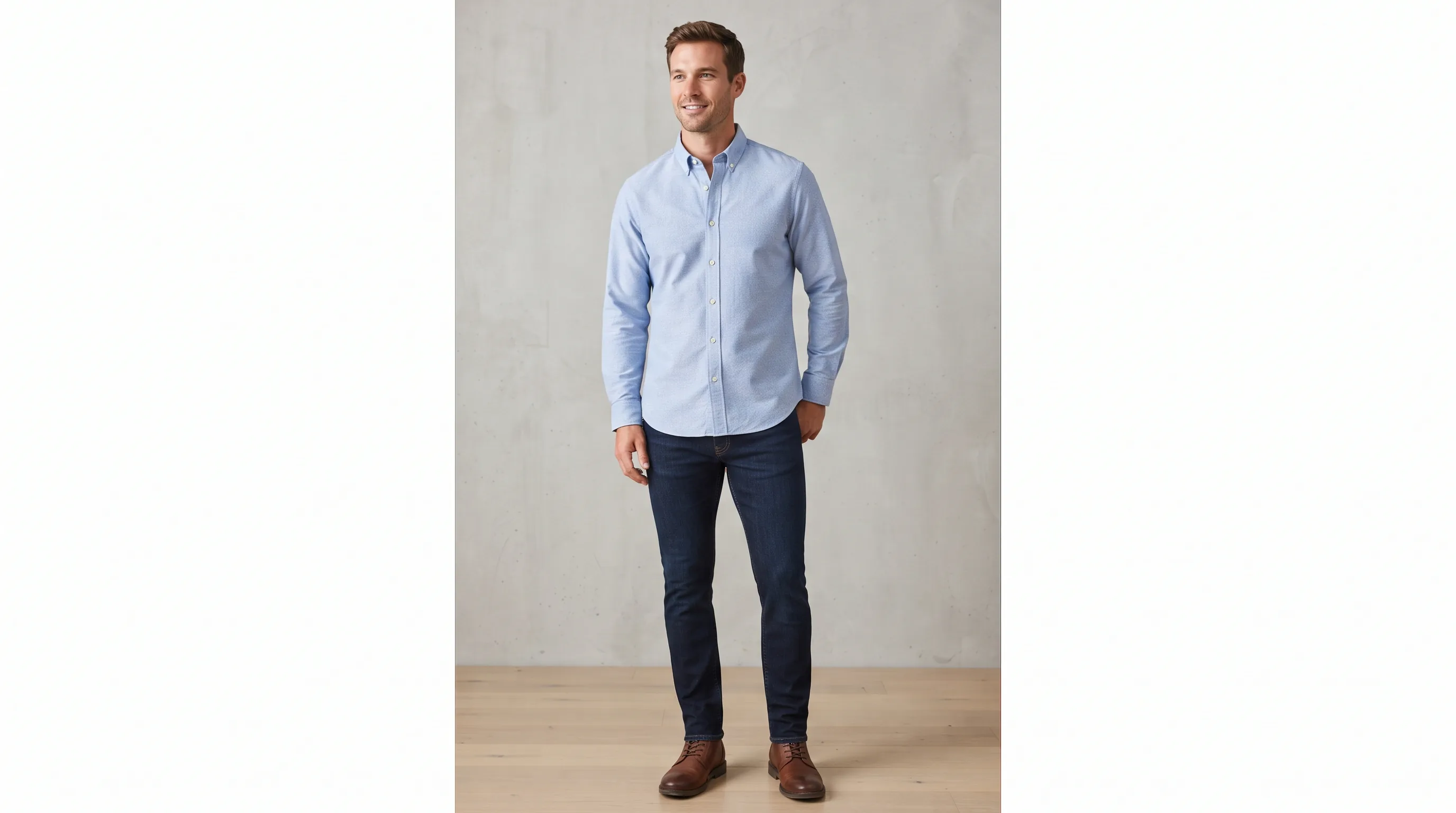
A men's shirt, blazer, kurta, or pair of trousers communicates entirely different things when worn versus when flat. The shoulder fit, the length from hip to hem, the way a collar sits, the drape of a linen fabric at the chest: none of this is visible in a flat lay. Research consistently shows that on-model photography outperforms flat lay and ghost mannequin for apparel sales, because it gives buyers the two pieces of information they need: does it fit a body like mine, and does it look the way I imagine it looking?
Yet for most small and mid-size Indian menswear brands, the cost of on-model photography is prohibitive at the catalog scale they require. A menswear brand with 80 SKUs that books a male model for two days, at ₹15,000 per day minimum, and adds a photographer (₹10,000 per day), studio rental (₹8,000 per day), and sample logistics, arrives at ₹66,000 before post-production retouching. For 80 products. Per season. Three seasons per year means ₹2,00,000 in photography costs before the brand has sold a single unit.
Male models are significantly harder to source than female models in India
The Indian model industry has a significant gender imbalance. Female models are more available, more affordable, and more consistently booked across ecommerce studios. Male models, particularly models who can represent the Indian body-type diversity that Tier 2 buyers actually look like, are harder to book, often have higher day rates relative to female models, and are less available for the short-notice sessions that accommodate new product launches.
The practical consequence: most Indian menswear brands on Meesho, Flipkart, and mid-tier Myntra seller accounts default to flat lays or ghost mannequins. Not because they don't understand the value of on-model photography, but because they cannot operationally sustain the cost and logistics of male model shoots for their full catalog.
Platform compliance makes this existential, not optional
Myntra mandates gender-matched professional model shots for most apparel categories. Specific requirements include:
- Kurtas and ethnic wear: front AND back model shots mandatory. If the product includes a dupatta, it must be shown on the model.
- Jeans and trousers: belt loops must be visible in the primary shot; waistband styling matters.
- Western wear (shirts, casual wear): gender-matched model shots mandatory, minimum one full-length frame.
- All apparel: 3:4 portrait ratio (1500 x 2000px minimum), light grey or clean neutral background.
A menswear seller who lists on Myntra with flat lays or ghost-mannequin images is either getting listings rejected at submission or suffering catalogue suppression in search results. Both are existential problems for a brand whose entire revenue depends on platform visibility. For the full spec, see our Myntra photoshoot requirements checklist.
India's Menswear Opportunity: The Scale of the Market Requires Scale of Visual Content
The menswear opportunity is concentrated in exactly the seller segment that traditional photography pricing most disadvantages: small and mid-size D2C brands in Tier 2 and Tier 3 cities, Jaipur, Surat, Ludhiana, Tiruppur, that are manufacturing strong products but cannot build the visual production infrastructure that metro-based competitors take for granted.
A kurta manufacturer in Jodhpur producing 400 new SKUs per season does not have a professional photography studio two blocks away. They ship samples to Delhi or Mumbai, wait two weeks for photos, pay for the return, and discover three weeks later that Myntra has rejected 30% of submissions for non-compliant backgrounds or missing back shots. The entire production cycle repeats. AI menswear photography eliminates this loop entirely.
The Three Menswear Photography Formats: When to Use Each
Indian menswear brands need three types of product image across their catalog workflow. Understanding what each format accomplishes, and where each belongs, is the foundation of a scalable menswear photography strategy.
| Format | What it answers | Where it belongs |
|---|---|---|
| On-model | Does this fit and look right on a real body? | Primary listing image; Myntra-mandated categories |
| Ghost mannequin | What is the exact cut and silhouette? | Secondary listing image; clean white-background catalog |
| Flat lay | What are the true colour, pattern, and fabric? | Detail image; Instagram; wholesale catalogs |
Each format answers a different buyer question, and the AI workflow below generates all three from a single source photo. To see the on-model format in production, explore Scalio's AI fashion photography feature.
Platform Compliance Map: What Each Indian Marketplace Requires for Menswear
Each Indian marketplace has different menswear photography requirements. The table below maps the specifics for the categories most relevant to menswear brands. Always verify current requirements at each seller portal before publishing, as marketplace policies change.
| Marketplace | Model shot | Background | Ratio / size | Menswear notes |
|---|---|---|---|---|
| Myntra | Gender-matched model mandatory | Light grey / clean neutral | 3:4 portrait, 1500 x 2000px min | Front and back for ethnic wear; dupatta shown on model |
| Amazon India | Model or mannequin accepted | Pure white for main image | Square or portrait, high resolution | Product fills most of the frame; no props on main image |
| Ajio | On-model preferred for fashion | Clean neutral studio | Portrait | Consistent styling across the size range |
| Flipkart | Model or ghost mannequin accepted | White / clean | Portrait | Full garment visible; belt loops for trousers |
The AI Menswear Photography Workflow: Step by Step
The AI menswear photography workflow has five steps. The first step, the source photo, is the only one that requires any physical work. Everything after it is done inside Scalio.
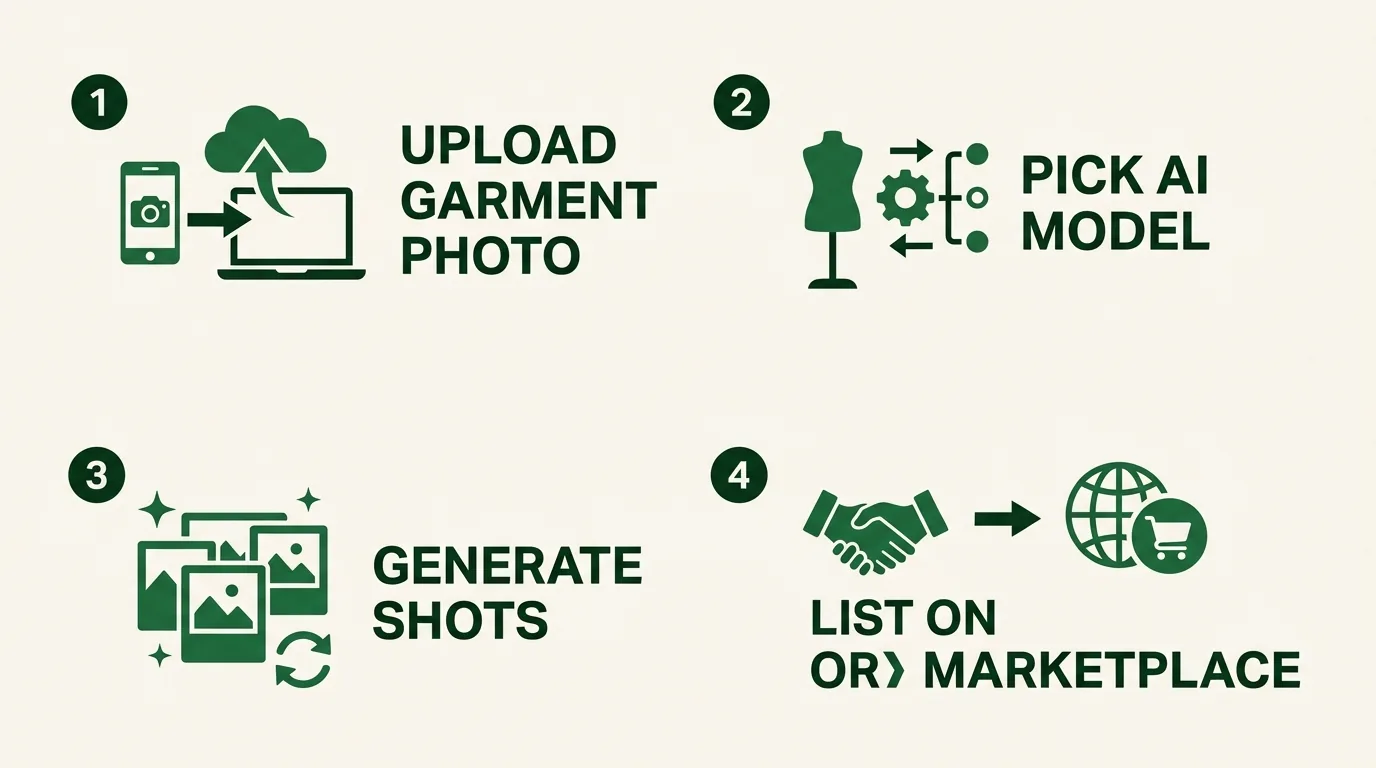
- Photograph the garment on a plain mannequin or hanger with even light.
- Upload the source image into Scalio.
- Choose the output format: on-model, ghost mannequin, or lifestyle.
- Generate the on-model output in the Myntra light-grey 3:4 portrait preset.
- Upload the finished image straight to your marketplace listing.
From source photo to published Myntra listing in under five minutes.
Source photo tips specific to menswear
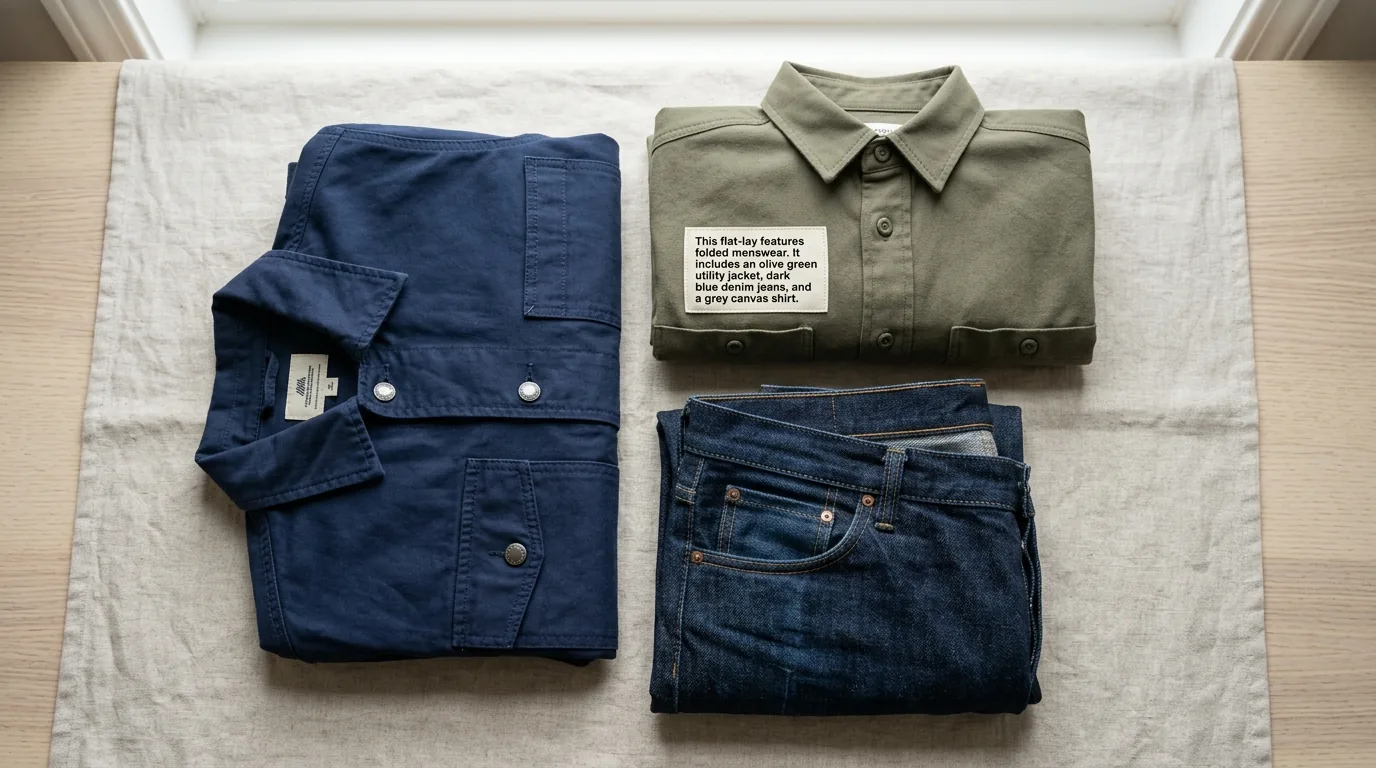
- Shirts and formal wear: photograph front-facing on a mannequin with the collar buttoned and sleeves at natural fall. Unbutton one collar button for casual styles. The collar area is where AI generation quality is most visible: a well-photographed collar in the source produces a realistic AI output, while a collapsed or folded collar produces artefacts.
- Kurtas and ethnic sets: photograph front AND back on the mannequin, as you will need both for Myntra compliance. If the product includes a pyjama or churidar, include it in the photograph for the set listing image.
- Jackets and blazers: photograph with a plain t-shirt or shirt underneath. AI menswear generation handles structured outerwear much better when there is a visible underlayer, because the AI understands that the jacket is a separate piece from the body. A jacket photographed directly on a bare mannequin can produce unnatural chest and shoulder generation.
- Trousers and jeans: include the full garment from waistband to hem. Belt loops must be visible in the Myntra submission. Photograph the waistband closed, as worn, not folded over.
- Textured fabrics (tweed, wool, velvet, embroidered ethnic): source resolution is everything. Shoot close enough that the fabric texture is clearly visible in the source photo. The AI preserves what it clearly sees; a blurry source produces blurred texture in the output, and no prompt can compensate for a low-resolution source.
AI Performance by Menswear Category: What Works Best Today
AI menswear photography performs differently across product categories. This table reflects the current state of AI generation quality for Indian menswear as of mid-2026, and where real-model photography still justifies the investment.
| Category | AI performance today | Recommendation |
|---|---|---|
| Shirts, t-shirts, casual wear | Excellent | Use AI for the full catalog |
| Trousers, jeans, chinos | Strong | Use AI; keep belt loops visible in source |
| Kurtas and plain ethnic sets | Strong | Use AI for front, back, and variants |
| Blazers and structured outerwear | Good with an underlayer | Use AI; shoot over a plain shirt |
| Heavy-embroidered sherwanis, bandhgalas | Good for variants, gap on hero | One real-model hero, AI for variants and context |
Festive and Wedding Season: The Highest-Value AI Use Case for Indian Menswear
Indian menswear has a seasonal sales structure unlike any other apparel market. Diwali, Eid, and the October to March wedding season drive a disproportionate share of annual revenue for ethnic and occasion-wear categories, and each event requires its own visual context. A kurta that sells year-round in a plain white-background catalog format sells dramatically better in Diwali season when the listing shows the garment in a contextually relevant festive setting.
This is where AI is unbeatable on economics. The same source photo can produce a Diwali version (warm golden ambient light, lit diyas, marigold bokeh), an Eid version (deep teal setting, lantern motifs, gold accent light), and a wedding-season version (dark marble, editorial luxury, warm spot lighting), all in one Scalio session, with no reshoot.
The Cost of Menswear Photography: Traditional vs AI
The economics are the reason menswear brands switch. Traditional costs vary significantly by city (metro versus Tier 2), studio quality, and volume, so treat the figures below as directional. What does not change is the shape of the comparison: a traditional catalog shoot is a large fixed cost paid before a single unit sells, while AI is a small per-image cost paid as you list.
| Line item | Traditional (80 SKUs) | AI (Scalio) |
|---|---|---|
| Male model (2 days) | ₹30,000 | ₹0 |
| Photographer (2 days) | ₹20,000 | ₹0 |
| Studio rental (2 days) | ₹16,000 | ₹0 |
| Sample logistics + retouching | Additional | ₹0 |
| Per-image economics | High fixed cost per season | A few rupees per generated image |
For a deeper breakdown, read our AI photography cost advantage guide.
Frequently Asked Questions
Will AI-generated male model images pass Myntra's compliance review?
AI on-model images are accepted by Myntra when they accurately represent the garment and meet the format requirements: 3:4 portrait ratio, light grey or neutral background, full-length standing model, and the product clearly visible front and back where required. Myntra's compliance review focuses on image quality, background compliance, ratio, and garment accuracy, not on whether the model is real or AI-generated, provided the output looks professional and the garment is accurately shown. For best results, use Scalio's Myntra preset, which applies the correct background and ratio automatically. Always verify current Myntra policy at the Myntra Seller Portal before publishing.
Is AI good enough for embroidered ethnic wear like sherwanis and bandhgalas?
For standard sherwanis and bandhgalas with moderate embroidery, AI can generate adequate catalog images, particularly for secondary images, colour variants, and festive context scenes. The quality gap between AI and real-model photography is most visible in premium ethnic wear with heavy embroidery, complex zardozi work, or highly structured silhouettes where the drape and volume are significant selling points. Our recommendation: for hero and primary listing images of your signature sherwani collection, invest in one strong real-model shoot. Use AI for the variant colours, the festive context images, and the Instagram and Meta ad assets. The ROI calculation is different when one hero image supports 50 variant images.
How do I photograph a kurta set for AI processing when the set includes multiple pieces?
For kurta sets (kurta plus pyjama or churidar), photograph the complete set together on the mannequin, both pieces styled as they would be worn. This gives the AI the full information needed to generate a model wearing the complete set. For Myntra compliance, you need both a front shot and a back shot of the complete set. For the dupatta, if included, ensure it is draped visibly in at least one image per Myntra's category requirements. AI processes the complete styled mannequin image and generates the on-model output with all pieces intact. Photograph each piece separately only if you also want individual product images for the components.
Can I use the same AI model across my entire menswear catalog?
Catalog consistency is a genuine advantage of AI model photography. With traditional photography, model availability, day rate, and scheduling constraints often mean your catalog ends up photographed across multiple models, days, and lighting setups, producing visible inconsistency that reduces the perceived professionalism of the brand. AI lets you use the same model reference across your full catalog, the same body type, skin tone, and pose convention, producing consistency that only very large brands with dedicated photography contracts achieve traditionally. In Scalio's workflow, you can set model and styling reference parameters and apply them batch-wide across a collection.
What about size representation? Can AI show how a garment fits different body types?
AI model generation can produce the same garment on models with different body types, heights, and proportions, which was previously only possible by booking multiple models for the same shoot. For Indian menswear brands that sell across a range of sizes (S through 3XL), this is a significant opportunity: showing a shirt on both a slim-fit and a regular-fit model from the same product page helps buyers self-select the correct size and reduces returns from fit mismatches. The size-representation conversation is early in Indian ecommerce, but it is coming, and AI is the only way to produce it at reasonable cost for most brand sizes.
Ready to fix your menswear visuals?
Your product is already good. The images are what is holding the listing back. With AI, you can shoot every shirt, kurta, and blazer in your catalog on a consistent model, meet Myntra and Amazon India rules, and spin up festive context shots without a single reshoot, all from a plain source photo. Try it at web.scalio.app and turn your next catalog drop into listings that actually sell.