

Best time to post on LinkedIn: the short answer
An interior design consultant in Bangalore reads a "best time to post on LinkedIn" article, sets a calendar reminder for 8 AM sharp, and posts her project photos every weekday morning for a month. Three likes. Maybe a comment from her cousin. Then one Wednesday she forgets, posts at 2:30 PM instead while waiting for a client meeting, and the same kind of post pulls in 40 comments and two inbound leads. Nothing about the photo changed. The caption wasn't better. The only thing that moved was the clock, and even that isn't the full story.
Key definition: The best time to post on LinkedIn is the window when your specific professional audience is most actively engaging, not just scrolling, in their own time zone. Across large 2026 datasets this generally converges on Tuesday through Thursday, late morning to late afternoon, but LinkedIn's algorithm rewards how quickly a post earns real engagement more than the exact clock hour it goes live.
If you want the best time to post on LinkedIn without reading further: post on a weekday, Tuesday through Thursday, somewhere between late morning and late afternoon. That single change beats a random schedule more reliably than a better headline or a fancier graphic. But the more useful answer, the one that actually explains why her Wednesday post worked and her Monday 8 AM posts didn't, is below.
Direct answer: No, there is not one universal best time to post on LinkedIn that works for every account. There is a strong general pattern (weekday, late morning to late afternoon, Tuesday through Thursday), and LinkedIn's own algorithm rewards early engagement velocity over any single clock hour.
What Sprout Social and Buffer's 2026 data actually says
Two of the biggest social analytics companies published fresh 2026 breakdowns of LinkedIn timing, and they're worth reading together because they used different datasets and landed in a genuinely interesting disagreement.
Sprout Social's 2026 analysis, based on nearly 2 billion engagements across 307,000 profiles measured between November 2025 and February 2026, found the strongest windows to be Monday 1–2 PM, Tuesday 11 AM–5 PM, Wednesday 11 AM–4 PM, and Thursday 11 AM plus 1–5 PM. Their finding is blunt: "the best time to post on LinkedIn is Tuesdays from 11 a.m.–5 p.m.," with Wednesday and Thursday close behind, and weekends dead across almost every industry they measured.
Buffer's 2026 data, pulled from 4.8 million posts sent through their platform, tells a different story about when in the day. Their 2025 numbers showed engagement dropping off sharply after 5 PM, the classic "post before work" pattern. Their 2026 numbers show that pattern breaking. Peak engagement has shifted to 3–8 PM, with Wednesday at 4 PM, Friday at 3 PM, and Friday at 4 PM as the single highest-performing slots of the week. Monday and Tuesday, the days everyone assumes are best because that's when the office reopens, are now their weakest early-week days.
Read that mismatch carefully, because it's the actual takeaway. Both companies agree hard that Tuesday through Thursday beats every other day and that weekends are close to worthless for B2B reach on LinkedIn. Where they disagree is the hour, and Buffer's newer data suggests the old "post at 8 or 9 AM before people start their workday" advice, repeated on nearly every LinkedIn guide still online, may already be stale.
| Day | Sprout Social | Buffer |
|---|---|---|
| Monday | 1–2 PM | Weakest early-week day |
| Tuesday | 11 AM–5 PM | Weakest early-week day |
| Wednesday | 11 AM–4 PM | 4 PM (single best slot of the week) |
| Thursday | 11 AM, 1–5 PM | Strong, 3–8 PM window |
| Friday | Not called out | 3 PM and 4 PM (top slots) |
| Saturday/Sunday | Weakest overall | Weakest overall |
Treat this table as two independent measurements pointing at the same underlying pattern rather than a menu to pick one exact row from. Both sources agree on the days. The hour is shifting later, and worth testing directly against your own numbers instead of copying either chart wholesale.
Best time to post on LinkedIn by content format
Timing works differently depending on what you're posting. Supergrow's synthesis of four studies covering 8 million-plus posts notes that LinkedIn is pushing video hard right now, rolling out a short-form video feed similar to Instagram Reels or YouTube Shorts. Video and document carousels get distributed over a longer stretch of time than a single text post, meaning the exact hour matters less for a video than it does for a plain text update that leans entirely on your existing followers scrolling at that moment. If you're mixing formats across a week, treat the hourly windows above as a firmer rule for text posts and a softer one for video.
Why LinkedIn's algorithm makes clock time less important than you think
Every article on this topic, including the two just cited, hands you a chart and stops there. What almost none of them explain is why two accounts posting at the identical hour get wildly different results, and one LinkedIn creator's explanation is more useful than either dataset.
A LinkedIn growth coach who has published over 15,000 posts on the platform, grown his own following past 35,000, and helped more than 50 clients build a following, addressed this directly in a video breaking down the algorithm. His answer debunks the most common piece of advice out there: "there's no perfect posting time, LinkedIn prioritizes engagement velocity, not the exact time you post."
Key insight: LinkedIn tests every post inside your existing network first. Whether it gets pushed further depends on how much genuine engagement (real comments, not "great post!" one-liners) and dwell time it earns in roughly the first hour, not on which clock hour you hit publish.
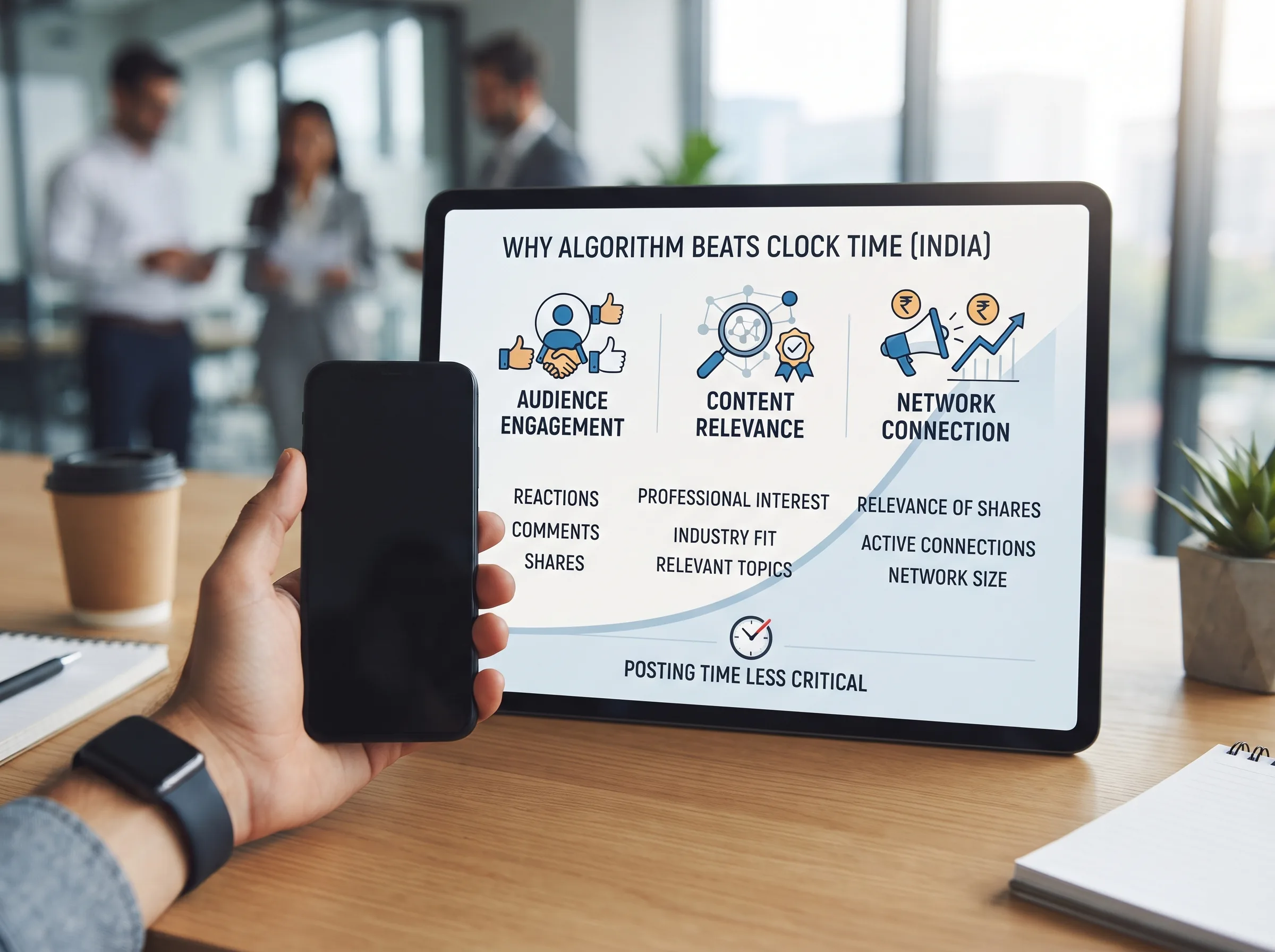
That's the actual mechanic behind the chart. LinkedIn shows your post to a slice of your network first. If people stop scrolling, read it, and leave a real comment, the platform reads that as a signal worth spreading further. If your post lands in an inbox full of scrollers who are half-asleep or mid-commute, it dies quietly regardless of what a Sprout Social table says about that hour. This is why picking Tuesday 11 AM helps on average, since more of your audience is awake and paying attention then, but it's a probability boost, not a guarantee. The consultant from the opening story posted at 2:30 PM by accident and got lucky with a batch of clients who happened to be between meetings and actually engaged, not because 2:30 PM is magic.
Finding your own best time to post on LinkedIn (IST-adjusted for Indian audiences)
Every study cited above was built on largely US and global-timezone data. If you're posting for a boutique in Jaipur or a consulting practice in Bangalore, those charts are a reasonable starting benchmark, but your own audience's habits are what actually decide your numbers.
Here's how to find your real answer in about five minutes:
- Open LinkedIn on desktop or the app and go to your profile.
- Tap Analytics (or the "Followers" tab if you're checking a Page), which shows follower activity broken down by day and hour.
- Look for the hour just before your steepest activity climb, not the exact peak. Posting slightly ahead of the rush gives your content time to gather that early engagement velocity discussed above before the crowd arrives.
- Post at that adjusted slot for two weeks and compare it against your old, random posting habit using the same metric (comments, not just impressions).
- Re-check monthly. Follower activity shifts as your audience grows or changes.
For most ICP3-style accounts we see, salons, boutiques, and solo consultants, this individualized read tends to land close to the Sprout/Buffer windows adjusted into IST: a late-morning slot works for professionals checking LinkedIn over chai before meetings start, and a mid-to-late-afternoon slot works for the post-lunch scroll. But "close to" isn't "identical to," which is exactly why checking your own analytics beats copying a US chart wholesale.
Best day to post on LinkedIn: does the day matter more than the hour?
Across every source cited here, day matters at least as much as hour, arguably more, and LinkedIn is stricter about this than Instagram. A decent hour on Wednesday consistently beats a "perfect" hour on Saturday. That's not a small edge. It's because LinkedIn usage tracks the working week directly: people check it around meetings, commutes, and lunch breaks on a weekday, and mostly forget it exists over the weekend since it's a professional network, not a leisure scroll app like Instagram or YouTube.
Think about what a manufacturer in Surat posting a factory update or a case study is actually competing against. A Friday afternoon post sits in front of an audience still in work mode, checking LinkedIn between calls. The same post at a "quiet hours" Saturday morning slot is competing with almost nobody, because almost nobody with a B2B mindset opens the app on a Saturday morning. If you only have bandwidth to fix one habit this week, stop posting on weekends before you worry about the exact hour.
Turning LinkedIn timing into an actual posting habit
Knowing your window solves half the problem. The other half, the one that actually derails most small business owners, is having something ready to post into that window when Tuesday 2 PM shows up. It's easy to know your slot and still miss it because the post idea isn't written, the photo isn't picked, or LinkedIn wasn't even on the radar that week, since most local businesses associate LinkedIn with job-hunting, not marketing.
That's less a timing problem and more a content calendar problem, and it's worth solving on its own. If your LinkedIn presence keeps slipping because you're already juggling Instagram, client calls, and everything else running a salon or a boutique demands, the fix isn't a sharper posting-time chart, it's a native way to actually queue posts so your best window doesn't depend on you remembering in real time. If you're figuring out timing for Instagram alongside LinkedIn, our best time to post on Instagram breakdown covers that side with the same real-data approach.
Scalio turns a product photo and a short brand brief into model-wearing photos and Reels in minutes, and includes a content calendar so you always have something ready to drop into your best window, instead of scrambling together a post at 1:55 PM on a Tuesday. It replaces the shoot, the studio, and the agency retainer, from ₹999/month against a ₹10K+/month agency. See how it works →
Frequently Asked Questions
What is the single best time to post on LinkedIn?
There's no single universal time. Sprout Social points to Tuesday 11 AM–5 PM as the strongest window, while Buffer's newer 2026 data shows engagement shifting toward 3–8 PM, with Wednesday 4 PM as their top slot, overturning the old "post before work" advice. LinkedIn's own algorithm rewards early engagement velocity in roughly the first hour more than any specific clock time.
Does the best time to post on LinkedIn matter for video vs. text posts?
Yes. LinkedIn is actively pushing video distribution right now, giving video and document posts a longer reach tail than a single text update, which leans almost entirely on your followers being online the moment you post. If you're mostly posting video, treat the hourly windows above as a looser guide.
What's the worst time to post on LinkedIn?
Weekends, consistently, across every study cited here. Unlike Instagram, where weekends are merely weaker, LinkedIn usage tracks the working week closely since it's a professional network, so Saturday and Sunday posts get buried in front of an audience that mostly isn't checking the app.
How do I find the best time to post for my specific LinkedIn audience?
Open your LinkedIn Analytics (or Page followers tab) and check your audience's most active hours by day. Post shortly before your steepest activity climb, not during the peak itself, so your content has time to build engagement velocity before the wider crowd arrives. Two weeks of testing against your old habit will tell you if it's meaningfully different for your account.
Does the best time to post on LinkedIn change for Indian audiences specifically?
The cited studies lean US and global-timezone weighted, so treat the Sprout Social and Buffer windows as a starting benchmark, not a fixed answer, for an IST audience. A Bangalore consultant or Jaipur boutique owner should verify against their own LinkedIn Analytics, since local habits like a pre-meeting chai scroll or a post-lunch check-in can shift the real window earlier or later than the global average suggests.