

Best time to post on Instagram: the short answer
A salon owner in Koramangala posts three Reels in the same week, same quality, same effort. One goes up at 11 PM after closing. One goes up mid-haircut, whenever she remembers. One goes up the next morning because she forgot the night before. Two get 40 views. One gets 4,000. Nothing about the content changed. The only variable was the clock.
Key definition: The best time to post on Instagram is the window when your specific audience is most actively scrolling in their own time zone. Across large datasets this generally converges on Tuesday and Wednesday afternoons, but the precise window varies per account and is only reliably known from that account's own Insights data.
If you want the best time to post on Instagram without reading the rest of this article: post on a Tuesday or Wednesday afternoon. That single move puts you ahead of a random schedule more reliably than almost anything else you could do to a caption or a filter. Everything below is the data behind that answer, and a better one once you have five minutes to check your own account.
Direct answer: No, there is not one universal best time to post on Instagram that works for every account. There is a strong general pattern (Tuesday/Wednesday afternoons), and a more precise, individual answer available in your own Instagram Insights.
What Sprout Social and Hootsuite's 2026 data actually says
Two of the largest social analytics companies published fresh 2026 breakdowns, and it's worth reading both because they used different datasets and still landed in roughly the same place.
Sprout Social's 2026 analysis, based on nearly 2 billion engagements across 307,000 global profiles, found the strongest windows to be Monday 2–4 PM, Tuesday 1–7 PM, Wednesday 12–9 PM, and Thursday 12–2 PM. Tuesday and Wednesday consistently produced the highest peak engagement of the week, and weekends were the weakest across almost every industry they measured.
Hootsuite's 2026 data, published in partnership with Critical Truth off more than 1 million posts and updated the day before this article was researched, breaks it down by day: 3–9 PM Monday, 5–8 AM and 3–7 PM Tuesday, 5 PM Wednesday, 4–5 PM Thursday, 4 PM Friday, 11 AM and 5 PM Saturday, 12–3 PM Sunday. Their broader finding: engagement peaks in early mornings and early evenings, especially earlier in the week.
The exact hours don't match one-to-one between the two, and that mismatch is itself the honest takeaway. There is no single universal minute. But both studies agree hard on the pattern: Tuesday and Wednesday beat every other day, afternoons beat early mornings and late nights, and weekends underperform almost everywhere. That pattern, not a specific clock time, is what you should actually take from either report.
| Day | Sprout Social | Hootsuite |
|---|---|---|
| Monday | 2–4 PM | 3–9 PM |
| Tuesday | 1–7 PM | 5–8 AM, 3–7 PM |
| Wednesday | 12–9 PM | 5 PM |
| Thursday | 12–2 PM | 4–5 PM |
| Friday | Not called out | 4 PM |
| Saturday | Weakest overall | 11 AM, 5 PM |
| Sunday | Weakest overall | 12–3 PM |
Read this table as two independent measurements of the same underlying pattern, not a menu to pick a single row from. If you only remember one thing from it: both companies agree Tuesday and Wednesday afternoons are safe bets, and both agree the weekend is where engagement goes to die.
Best time to post Reels vs. photos vs. carousels
Timing matters differently depending on format. Reels get pushed through Explore and suggested feeds over a much longer tail than a feed post, so a Reel posted at 11 AM can still pick up meaningful reach at 4 PM in a way a static photo won't. A photo or carousel leans almost entirely on your existing followers scrolling at the moment you post, which is why the Sprout and Hootsuite windows above matter more for photos and carousels than for Reels. If you're mixing formats in one week, treat the "best time to post Reels on Instagram" question as a softer constraint than a feed post's.
What Instagram itself says about the "best" time
Every article on this topic, including the two just cited, points you toward an aggregate study. Almost none of them mention that Instagram's own Head of Product has already answered the question directly, and his answer is more useful than either dataset.
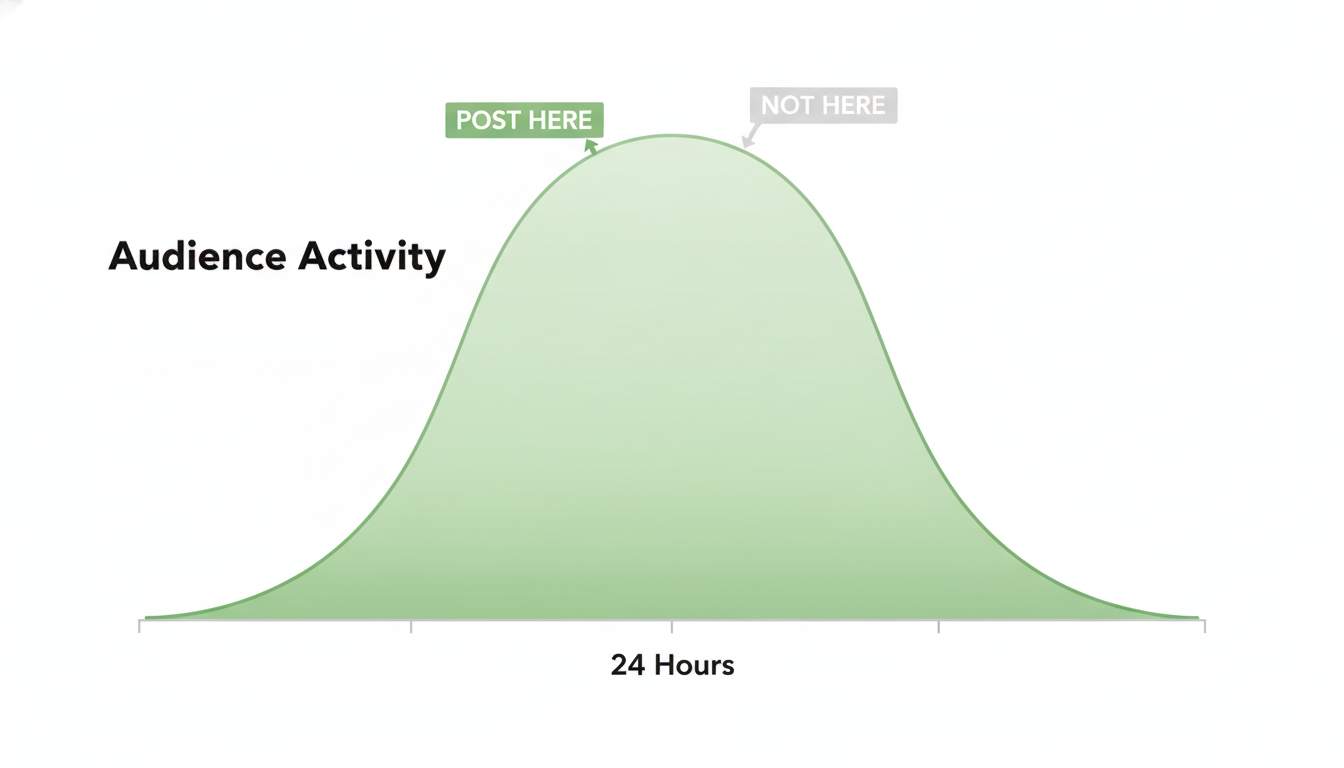
Adam Mosseri was asked on his Instagram Stories Q&A whether there's an optimal time to post. His answer: "There is no one optimal time to post, but I do think it's usually good early in the day for most of your followers... if you go to your insights, you can see what time of day you have the most followers, and I like to post before that peak starts to grow."
That last part is the detail worth sitting with. The instinct most people have is to post during their peak activity window, chasing the moment the most people are already online. Mosseri's advice is the opposite: post shortly before your audience peaks, so your content is already sitting in the feed and gathering early engagement signals by the time the crowd shows up. Early engagement is what the algorithm uses to decide whether to keep showing your post to more people. Arrive after the peak and you're competing with everyone else's fresh posts for the same shrinking window.
This is also the reason Sprout and Hootsuite's numbers don't need to match exactly. They're describing when audiences generally are online. Mosseri is telling you to post relative to your specific audience's peak, which any individual account can only get from its own Insights, not from a global study.
Key insight: Post shortly before your audience's activity peak, not during it. Arriving early lets your post accumulate engagement signals before the algorithm has to compete your content against everyone else's fresh posts during the actual rush.
Finding your own best time to post (IST-adjusted for Indian audiences)
Every study above was built on largely US and global timezone data. If you're running an account for a Bangalore salon or a Jaipur boutique, the Sprout and Hootsuite windows are a reasonable starting benchmark on your first week, but your own audience's habits, and their timezone, are what actually decide your numbers.
Here's how to find your best time to post on Instagram in five minutes:
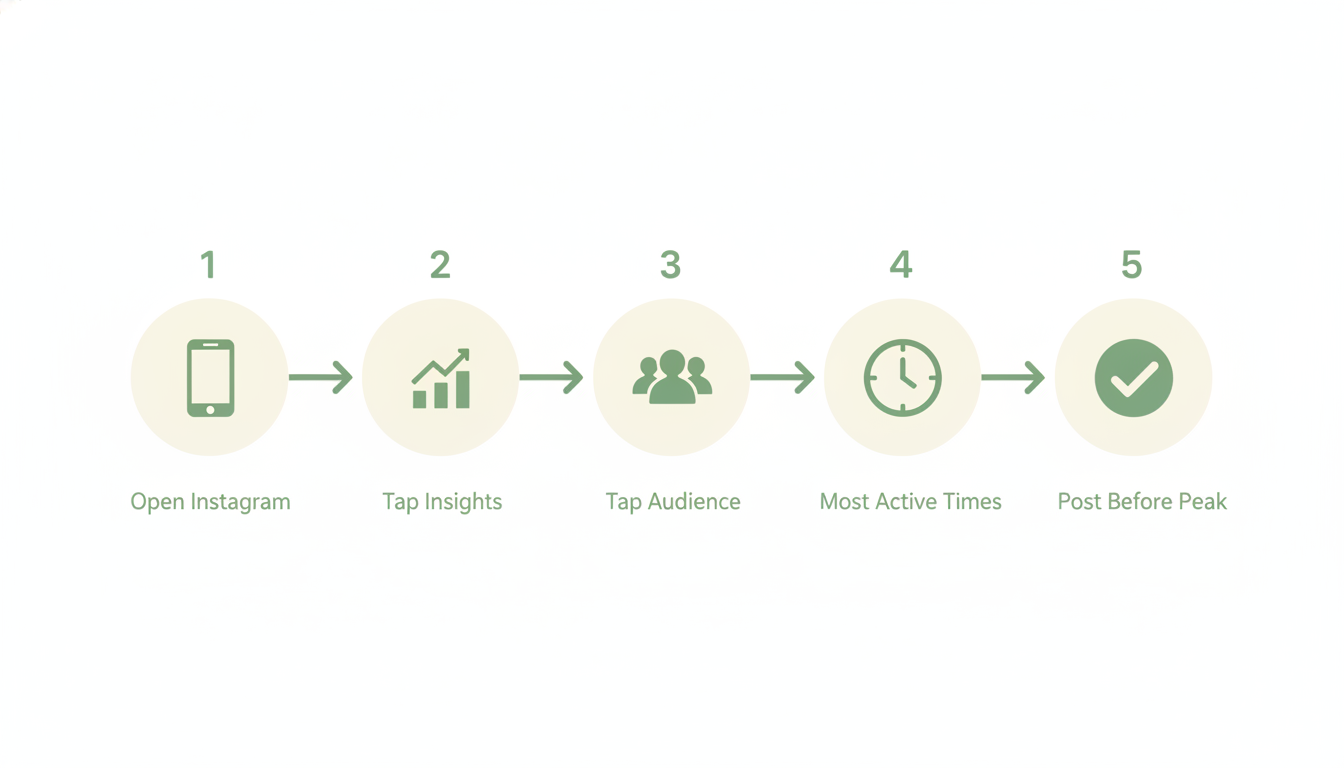
- Open your Instagram app and switch to a Professional account if you haven't (Settings → Account type).
- Go to your profile, tap Insights, then Audience.
- Scroll to Most Active Times, which shows you exactly when your followers are online, hour by hour, day by day.
- Note the hour just before your steepest climb. That's your Mosseri-style posting slot, not the peak itself.
- Post there for two weeks and compare reach against your old, random posting habit.
For most ICP3-style accounts we see, this individualized read ends up close to the Sprout/Hootsuite windows adjusted into IST: a late-morning or early-afternoon slot works for audiences checking Instagram on a lunch break, and an early-evening slot works for audiences scrolling after work. But "close to" isn't "identical to," which is exactly why checking your own Insights beats copying a global study wholesale.
Best time to post on Instagram today: does the day of the week matter more than the hour?
Across both sources, day matters at least as much as hour, arguably more. A decent hour on a strong day consistently outperforms a great hour on a dead day. If you're deciding what to do with today's post and you don't have time to check Insights, the fastest useful decision isn't picking the perfect hour, it's checking whether today is Tuesday or Wednesday. If it is, almost any afternoon slot beats a perfectly-timed Saturday post. If it's a weekend, both studies suggest lowering your expectations regardless of the hour you choose.
This is easy to underweight because "best time to post" sounds like an hour question by default. But think about what's actually happening on a Saturday versus a Wednesday for most audiences: weekday scrolling is broken into small, frequent windows around work, commutes, and lunch breaks, which is exactly the kind of "check Instagram for two minutes" behavior that rewards a well-timed post. Weekend scrolling is longer but far less frequent, and far more likely to be filled with content from people already followed closely, not new discovery. A boutique in Jaipur posting a festive collection at the "perfect" 5 PM Saturday slot is still competing with a fundamentally quieter, less discovery-friendly feed than the same post at an average Tuesday hour.
Turning this into an actual posting habit
Knowing your window solves half the problem. The other half, the one that actually derails most local business accounts, is having something ready to post into that window when it arrives. It's easy to know Tuesday 1 PM is your slot and still miss it because the caption isn't written, the photo isn't picked, or nothing was planned for that day at all.
That's less a timing problem and more a content calendar problem, and it's worth solving separately. If you're already stuck between client appointments with a folder of unedited photos, the fix isn't a better posting-time chart, it's a running list of content ideas you can pull from in under a minute, and a native way to actually queue posts so the right slot doesn't depend on you remembering in real time. If you're also building a presence on LinkedIn, our best time to post on LinkedIn breakdown covers that platform's B2B timing with the same real-data approach.
If you're spending more time deciding what to post than when to post it, Scalio turns a product photo and a short brand brief into model-wearing photos and Reels in minutes, and includes a content calendar so you always have something ready to drop into your best window, instead of scrambling at 12:55 PM on a Tuesday. It replaces the shoot, the studio, and the agency retainer, from ₹999/month against a ₹10K+/month agency. See how it works →
If your business also runs a Facebook Page, the timing logic carries over with its own separate data. Our best time to post on Facebook guide covers the Sprout Social and Buffer 2026 windows and a 5-minute way to find your Page's actual best time.
Timing is only half the equation. If you're still figuring out how many times a week to actually show up, our how often to post on social media guide breaks down the per-platform cadence with the same real-data approach.
Frequently Asked Questions
What is the single best time to post on Instagram?
There's no single universal time. Sprout Social and Hootsuite both point to Tuesday and Wednesday afternoons as the strongest general window across their datasets, but Instagram's own Adam Mosseri says the more reliable approach is checking your personal Insights and posting shortly before your specific audience's peak activity time, not copying an aggregate study exactly.
Is the best time to post Reels different from photos?
Yes. Reels get distributed through Explore and suggested feeds over a longer stretch of time, so posting time matters less for a Reel than for a feed photo or carousel, which depends heavily on your followers being online right as you post. If you're mostly posting Reels, treat the hourly windows above as a loose guide rather than a hard rule.
What's the worst time to post on Instagram?
Weekends underperform across nearly every industry in both the Sprout Social and Hootsuite datasets, with Saturday and Sunday consistently posting the lowest engagement of the week. Weekend scrolling tends to be longer but far less frequent, which favors accounts already followed closely over new discovery. If you only have bandwidth to fix one habit, stop treating Saturday and Sunday as your primary posting days.
How do I find the best time to post for my specific account?
Open Instagram Insights, tap Audience, then Most Active Times. Note the hour just before your steepest activity climb and post there, per Adam Mosseri's own advice, rather than during the peak itself. Two weeks of testing against your old posting habit will tell you if it's actually different for your audience.
Does the best time to post change for Indian audiences specifically?
The published studies lean US and global-timezone weighted, so treat the Sprout and Hootsuite windows as a starting benchmark, not a fixed answer, for an IST audience. A Bangalore or Jaipur small business should verify against their own Instagram Insights, since local habits like lunch-break scrolling can shift the real window earlier or later than the global average suggests.