

Best time to post on TikTok: the short answer
A boutique owner in Jaipur posts three TikToks in one week: same product, same lighting, same fifteen seconds of effort. One goes up at 9 AM before the shop opens. One goes up at 2 PM during a lull. One goes up at midnight because that's when she finally sat down. The 2 PM one gets 200 views and dies quietly. The midnight one gets 40,000 views and three new orders. Nothing about the video changed, and the honest answer isn't in any chart she'd find by Googling "best time to post on TikTok."
The honest answer: the three biggest studies on this topic don't agree with each other. Sprout Social says weekday afternoons. Buffer says Sunday morning. RecurPost says Monday and Friday evenings. If you're expecting one clean hour that works for everyone, it doesn't exist, and that disagreement is the most useful thing you can learn before reading another "best time to post" chart.
Key definition: The best time to post on TikTok is the window when your specific audience is scrolling the For You Page, not a fixed global hour. Large-scale studies disagree more on TikTok than on any other platform because TikTok's algorithm decides reach mostly through how your video performs after posting, not who was online when you hit publish.
Short version: post consistently, avoid true dead hours like 4-5 AM, and check TikTok's own analytics instead of copying a US-timezone study wholesale.
Direct answer: No, there is not one universal best time to post on TikTok. Three major 2026 studies each point to a different peak window. TikTok's own For You Page mechanic means the exact hour matters less than what your video does in its first minutes online.
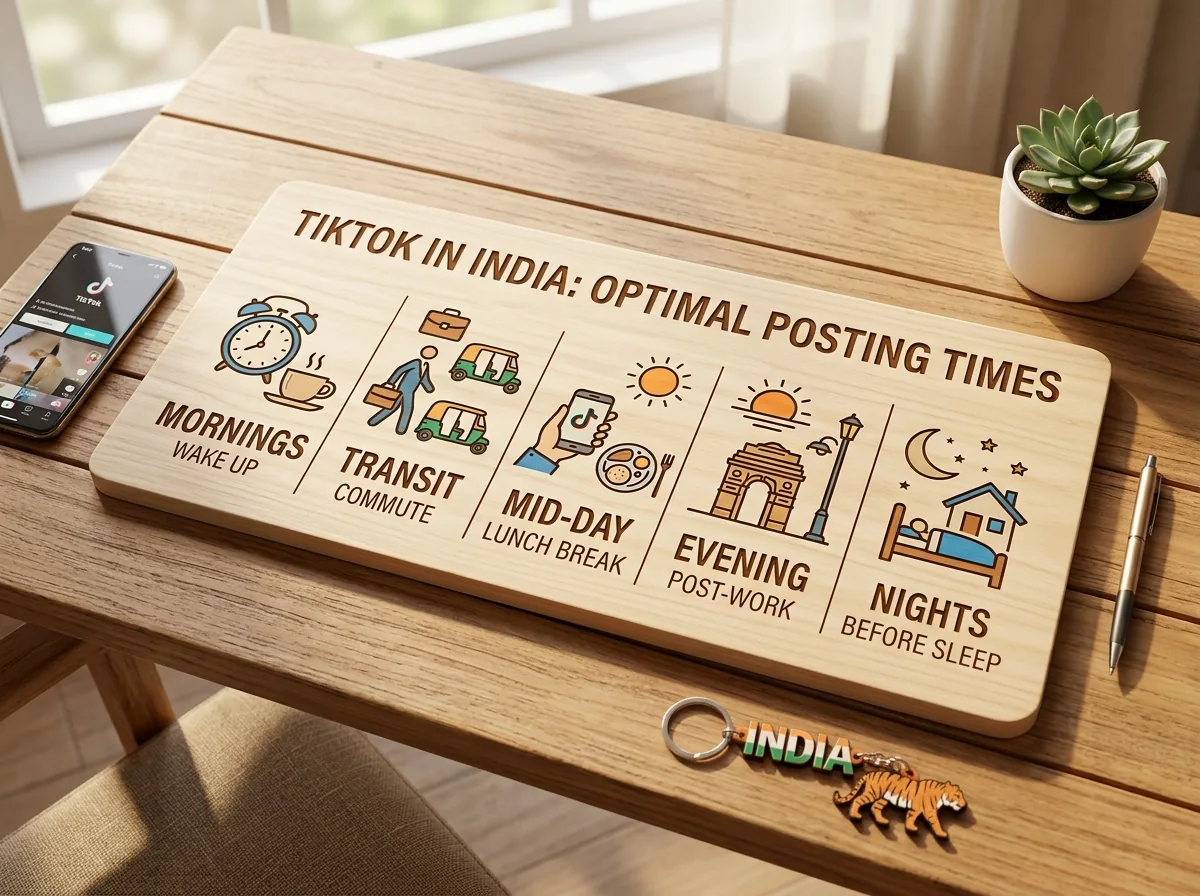
What Sprout Social, Buffer, and RecurPost's 2026 data actually says
Three of the biggest names in social analytics published fresh breakdowns for 2026, and reading all three side by side beats reading any one alone.
Sprout Social's 2026 analysis, based on nearly 2 billion engagements across 307,000 profiles, found the overall best times to be Tuesdays through Thursdays, 2 PM to 6 PM local time, with Sunday the weakest day.
Buffer's 2026 data, pulled from more than 7.1 million posts, found close to the opposite: the best slot was Sunday at 9 AM, followed by Monday 1 PM and Sunday 1 PM. Buffer also names Saturday the top-performing day, with evenings (6 PM–11 PM) beating afternoons most days.
A third source, RecurPost via SendOwl, covering 2 million posts through January 2026, lands somewhere else: Monday 1 PM, Friday 8 PM, and Saturday 8 PM (Eastern Time) as peak slots, with Tuesday, Thursday, and Friday the best days.
| Study | Best day(s) | Best time window |
|---|---|---|
| Sprout Social | Tuesday–Thursday | 2 PM–6 PM (local time) |
| Buffer | Saturday, with Sunday close behind | 9 AM Sunday peak; evenings 6 PM–11 PM generally |
| RecurPost via SendOwl | Tuesday, Thursday, Friday | Mon 1 PM, Fri 8 PM, Sat 8 PM (ET) |
Read this for the pattern, not the row. On Instagram, two major studies land close enough that Tuesday and Wednesday afternoons are a safe universal call. On TikTok, three studies point at three different days and windows, and none are wrong exactly, they measured different audiences over different months using different definitions of "engagement." Nobody has cracked one universal TikTok hour, because one doesn't exist.
Best time to post on TikTok by day of the week
For a day-by-day starting point (Eastern Time, from the RecurPost dataset), here's the most granular table available:
| Day | Suggested times | Why |
|---|---|---|
| Monday | 6 AM, 10 AM, 1 PM | Early risers, lunch-break scrollers |
| Tuesday | 9 AM, 1 PM, 4 PM | One of the highest-engagement days overall |
| Wednesday | 7 AM, 2–5 PM, 11 PM | Strong afternoon and late-night activity |
| Thursday | 9 AM, 12 PM, 7 PM | Midday breaks and evening wind-down |
| Friday | 5 AM, 1 PM, 3 PM | Afternoon performs well, evenings drop off |
| Saturday | 11 AM, 7 PM, 8 PM | Top overall engagement day in this dataset |
| Sunday | 7 AM, 9 AM, 1 PM | Morning posts outperform; 9 AM is a named peak slot |
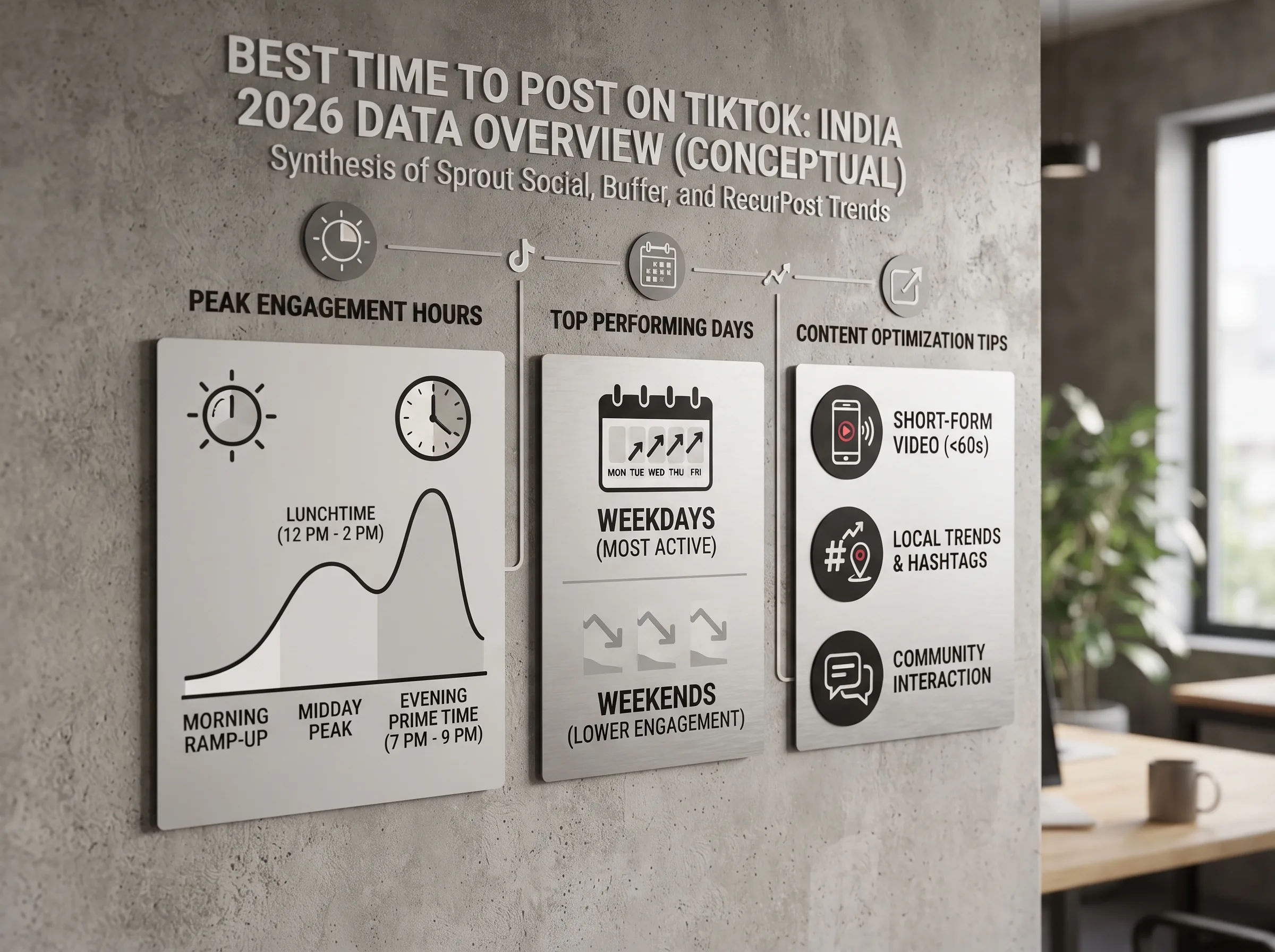
Treat this as a starting point for a US-timezone audience, not a rule. The next two sections explain why it matters less than you'd expect, and how to adjust it for an Indian audience.
Why timing matters less on TikTok than on Instagram
Every article on this topic treats "best time to post on TikTok" the way you'd treat "best time to post on Instagram": pick the hour, hit publish, wait for the algorithm to reward you. One TikTok-focused creator with a channel dedicated to explaining the algorithm says that's the wrong mental model entirely.
His claim, stated flatly: "Posting times do not matter. Post whenever you can, whenever you feel like it... the time you post has no effect on the views that you're going to get, as long as you're not posting at like 4:30 in the morning." His reasoning is structural: over 90% of TikTok views come from the For You Page, meaning people who've never seen your account, not existing followers scrolling at the moment you post.
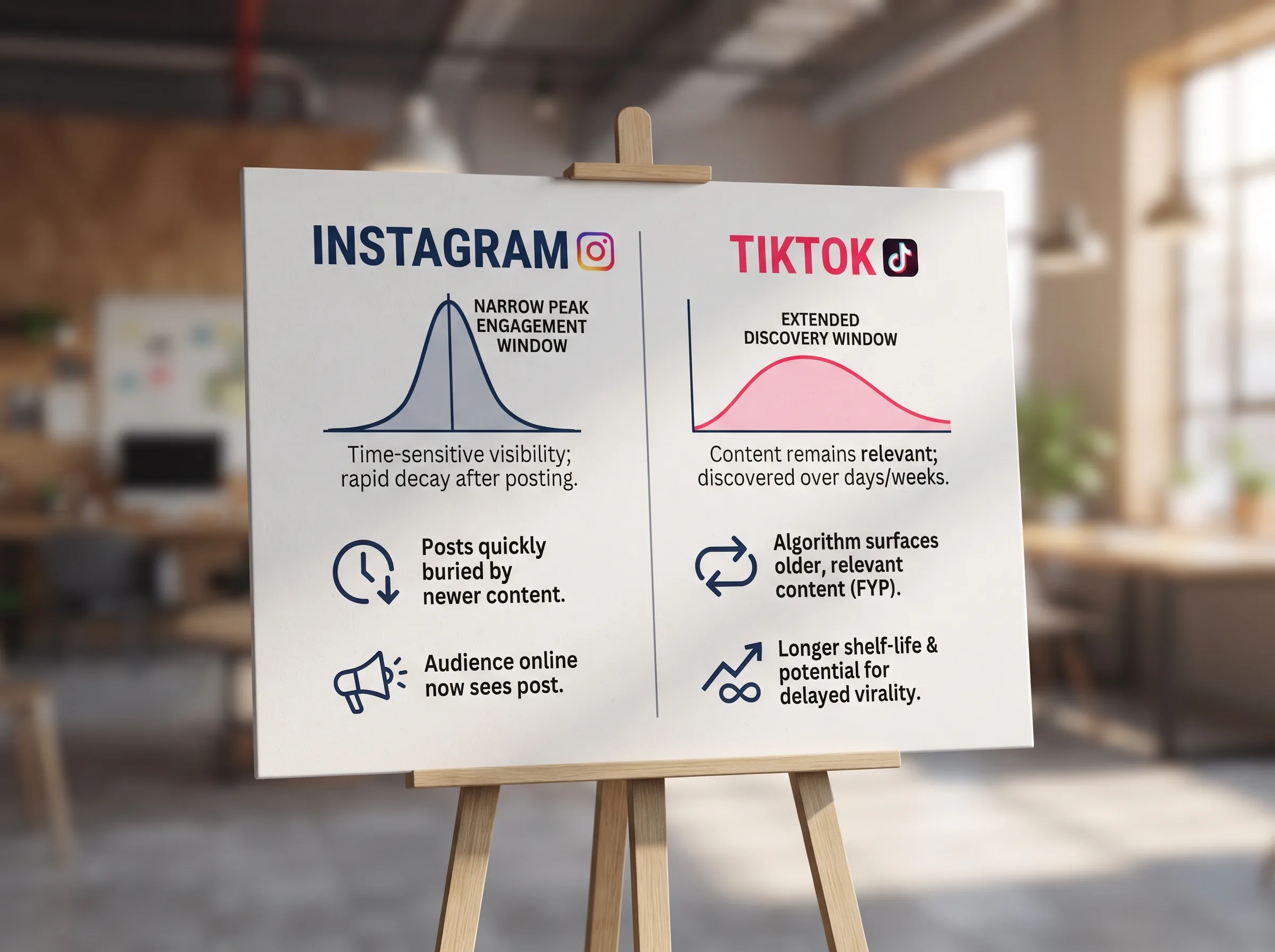
That fact explains the three-way disagreement above better than anything else. On Instagram, a feed post depends on your followers being online right when you publish, so timing against your audience's clock genuinely moves the needle. On TikTok, the For You Page pulls in a mostly cold audience over hours or days, so the exact minute you post matters far less than what the video does once live.
Key insight: TikTok's For You Page pulls most of its audience from people who've never seen your account, so the exact hour you post matters far less than what your video does in its first few minutes online. That's the structural reason the big studies disagree with each other, and why timing advice built for Instagram doesn't transfer cleanly to TikTok.
The 200-view test: what actually decides your reach
If timing isn't the main lever, what is? TikTok pushes every new video to a small test batch first, roughly 200 to 300 people, before deciding whether to expand it. Creators call this "200-view jail." SendOwl's breakdown of TikTok's 2026 ranking signals confirms the mechanic: completion rate is now the key bar for expanding distribution, up to roughly 70% (from about 50% in 2024), and "qualified views," watches longer than 5 seconds, are a core metric before a video escapes that test phase.
What decides whether your video clears the 200-view test is completion rate, rewatch rate, saves, and shares, roughly in that order, none of which are set by what time you posted. A product video watched to the end at 9 AM keeps expanding regardless of the hour; a video that loses viewers in three seconds stalls no matter how perfectly it was timed.
This is the gap every "best time to post" article misses: they treat the clock as the lever, when the real lever is whether your first 200 viewers stick around. Get the hook right and an "average" hour still climbs. Time it perfectly with a weak hook, and it dies in the test phase anyway.
Finding your own best time to post on TikTok (IST-adjusted for Indian audiences)
Every study above was built primarily on US and global-timezone data. If you're running a salon account in Bangalore or a boutique in Surat, those tables are a fine starting benchmark for week one, but your own audience's habits should decide your schedule after that.
Here's how to find your best time to post on TikTok for your specific account in about five minutes:
- Open the TikTok app and switch to a Business account (Settings and privacy → Account → Switch to Business Account, if you haven't already).
- Tap TikTok Studio, then Analytics.
- Go to the Followers tab and scroll to Most active times, which shows exactly when your followers are online, by day and hour, in your own timezone.
- Post slightly before your steepest activity climb, not during the peak itself: your video has time to build early engagement signals before the biggest wave of your audience shows up.
- Test that slot for two weeks and compare views and completion rate against your old, random posting habit.
For most India ICP3 accounts (salons, boutiques, local businesses), this individualized read lands close to the RecurPost table adjusted into IST: late morning for lunch-break scrollers, early evening for after-work winding down. "Close to" isn't the same as checking your own numbers.
Does posting frequency matter more than posting time?
If there's one number worth remembering over any specific hour, it's this: TikTok's own creator documentation recommends posting 1 to 4 times per day, and consistency over weeks is weighted more heavily than hitting an exact time slot. The same algorithm-focused creator makes this point directly: posting daily, even at inconsistent times, tends to outperform a perfectly-timed post that's part of a sporadic schedule, because TikTok rewards accounts that keep feeding it fresh content on a predictable cadence.
That's a hard ask for an owner juggling appointments and a shop floor. Knowing you should post daily doesn't help without four ideas a day to shoot, edit, and caption. This is really a TikTok posting schedule problem disguised as a "best time to post" problem.
Turning this into an actual posting habit
Knowing your window and frequency solves half the problem. The other half, the one that derails most local accounts, is having something ready to post into that window. It's easy to know 7 PM is your slot and still miss it three days running because nothing was planned for that day.
That's less a timing problem and more a content calendar problem, worth solving on its own. If you're comparing this to the best time to post on Instagram because you run both for the same shop, the method is nearly identical: check your own analytics, post slightly before your peak, stop copying a study built for someone else. What closes the gap is a running list of content ideas you can pull from in under a minute, and a proper posting calendar so the right slot doesn't depend on remembering.
If you're spending more time deciding what to film than when to post it, Scalio turns a product photo and a short brand brief into model-wearing photos and Reels in minutes, with a content calendar so you always have something ready for your best window. It replaces the shoot, the studio, and the agency retainer, from ₹999/month against a ₹10K+/month agency. See how it works →
Frequently Asked Questions
What is the single best time to post on TikTok in 2026?
There's no single universal time. Sprout Social, Buffer, and RecurPost each analyzed millions of posts and landed on different peak windows: weekday afternoons, Sunday morning, and Monday/Friday evenings. The pattern across all three: late mornings through evenings beat true late-night hours, but the exact hour depends on your audience.
Do posting times really matter on TikTok?
Less than you'd expect, and less than on Instagram. Over 90% of TikTok views come from the For You Page, meaning cold viewers who've never seen your account, so the algorithm weighs completion rate, rewatch rate, and shares far more than the hour you posted. Timing still matters at the extremes (avoid 4-5 AM), but it isn't the main lever.
What's the worst time to post on TikTok?
Very early morning, roughly 4-5 AM, is the closest thing to a genuine dead zone in the data. Beyond that, "worst time" is study-dependent: Sprout Social calls out Sunday as weakest overall, while Buffer shows Sunday morning as one of the strongest slots, the kind of disagreement that makes your own analytics more useful than a chart.
How often should I post on TikTok in 2026?
TikTok's own creator guidance recommends 1 to 4 posts per day, with consistency over weeks weighted more heavily than hitting a precise time slot. A steady daily habit at an "average" hour generally outperforms a perfectly-timed post that's part of a sporadic schedule.
Does the best time to post on TikTok change for Indian audiences specifically?
The published studies are all built on US and global-timezone data, so treat their tables as a starting benchmark, not a fixed answer, for an IST audience. A salon in Bangalore or a boutique in Jaipur should check TikTok Studio's own Most Active Times panel, since local habits like lunch-break browsing can shift the real window.