

Best time to post on Facebook: the short answer
A boutique owner in Jaipur runs her store's Facebook Page the same way every week: new arrivals photo on Monday, festive collection reel on Wednesday, customer review screenshot on Friday. Same effort, same camera, same captions written the same way. The Monday post gets 30 reactions. The Wednesday one gets 900 and three DMs asking for price. Nothing about the content changed between the two. The only thing that moved was when she hit publish.
That gap is what the best time to post on Facebook actually buys you: the same photo, seen by more of the people who were already going to see it, at the moment they're most likely to stop scrolling.
Key definition: The best time to post on Facebook is the window when your specific Page's followers are most active in their own time zone. Across large datasets this generally lands on weekday mornings through mid-afternoon, but the exact hour is only reliably known from your own Facebook Page Insights.
If you want the answer without reading the rest of this article: post on a weekday, somewhere between mid-morning and mid-afternoon, and stay off Saturday and Sunday. That single habit change beats almost anything else you could tweak about a post. Everything below is the data behind that, and a more precise answer once you have five minutes to check your own Page.
Direct answer: No, there's no single universal best time to post on Facebook for every Page. There's a strong general pattern (weekday mornings to mid-afternoon), and a more exact, personal answer sitting inside your own Facebook Page Insights right now.
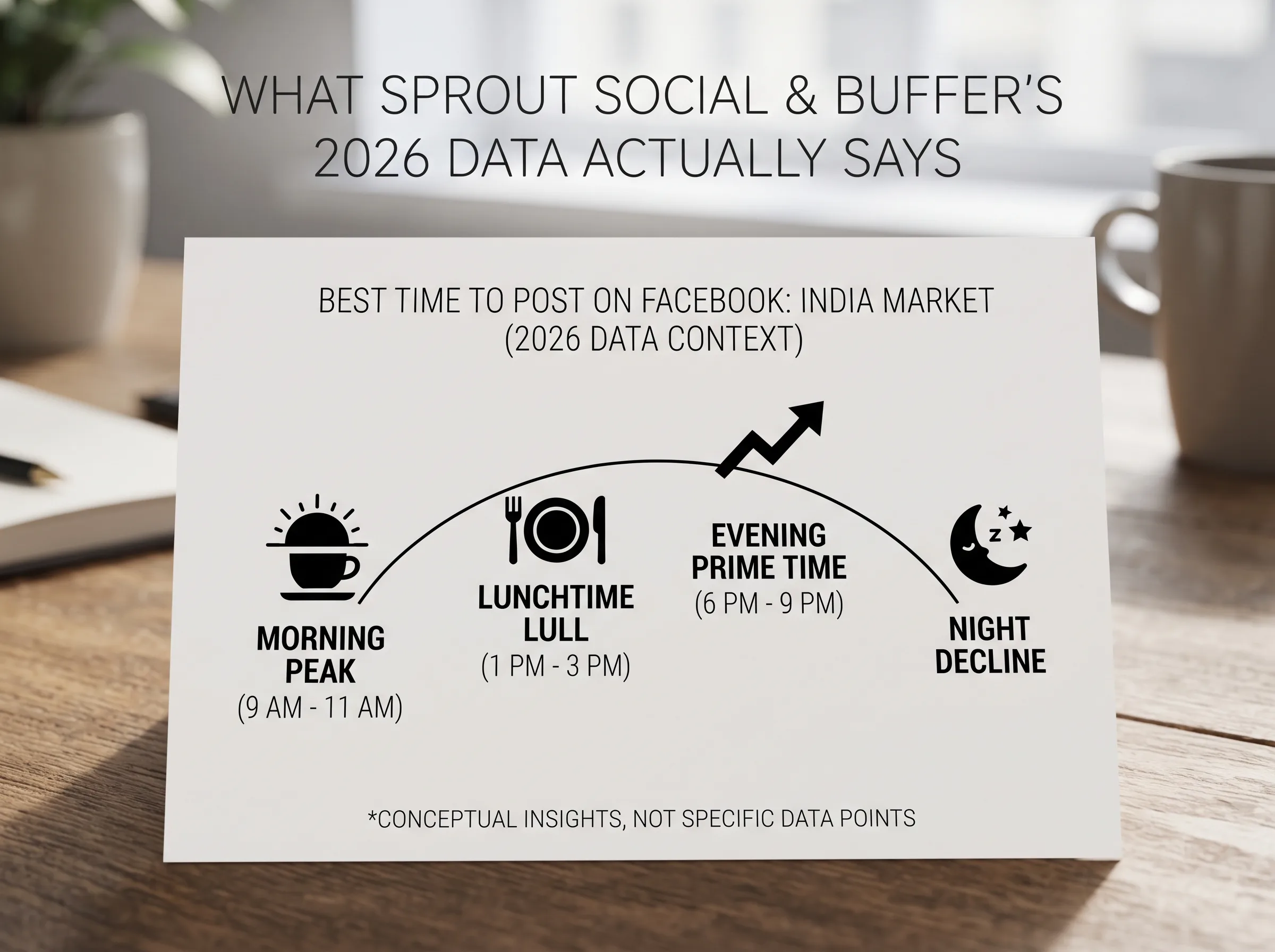
What Sprout Social and Buffer's 2026 data actually says
Two of the biggest names in social scheduling published fresh 2026 breakdowns of Facebook posting times, and they're worth reading side by side because they used different data and didn't land on the same hour.
Sprout Social's 2026 analysis, built on nearly 2 billion engagements across roughly 307,000 social profiles, found the strongest window to be Tuesdays and Wednesdays, 12–8 PM local time, with Mondays and Thursdays also showing solid afternoon spikes. Weekends were the weakest days across nearly every industry they measured.
Buffer's 2026 data, pulled from more than 14 million Facebook posts sent through their platform, points somewhere else: Thursday at 9 AM as the single strongest slot, with Wednesday and Sunday mornings also performing well, and engagement generally peaking between 6 AM and 11 AM on weekdays. Shopify's India blog runs with the Buffer number as its headline answer, and also notes that Facebook's average organic engagement rate held at 0.15% per post through 2025, per Socialinsider's benchmark data, unchanged from the year before.
Sprout says midday-to-evening, Tuesday and Wednesday. Buffer says early morning, Thursday. Neither is wrong, they just measured different customer bases with different tools. What both agree on, hard, is the shape of the week: weekdays beat weekends everywhere, and the worst time to post on Facebook is consistently a Saturday or Sunday, in both datasets, across nearly every industry. That agreement is what you should actually take from either report, not a specific clock number from either one.
| Signal | Sprout Social | Buffer |
|---|---|---|
| Strongest window | Tue/Wed, 12–8 PM | Thursday, 9 AM |
| Strong secondary days | Mon, Thu afternoons | Wed, Sun mornings |
| Weakest days | Weekends | Not called out as strongly, but mornings dominate weekdays |
| Sample size | ~2B engagements, 307K profiles | 14M posts |
Best time to post Facebook Reels vs. photos vs. links
Format changes the math. Video and Reels content on Facebook tends to keep gathering views for longer after posting than a static photo does, so the exact minute you publish a Reel matters less than the exact minute you publish a plain photo or a link post, which lean almost entirely on followers being online right when it goes up. If you're posting a mix of formats in one week, treat the hourly windows above as a firmer rule for photos and link posts, and a looser guide for Reels and video.
Why no single global answer works for your Facebook Page
Every article on this topic, this one included, is quoting an aggregate study built from thousands of unrelated accounts. That's useful as a starting point and genuinely limited as an answer, because your Page isn't an average of 307,000 profiles or 14 million posts. It's one specific group of people, with one specific set of habits.
One social media consultant put it plainly while walking through Facebook's own analytics on camera: there really is no global chart you can use to tell you exactly when to post, because each platform's engagement moves by hour and by day depending on who's actually following you, and once you're posting consistently, your own data is what tells you the truth. The same creator pointed out something the aggregate studies above don't capture at all: content type shifts the ideal hour too. Video tends to land better in the morning for some audiences, still images later in the afternoon for others, and the only way to know which applies to your Page is to look.
Key insight: Aggregate studies tell you where to start, not where to stop. Sprout and Buffer are measuring hundreds of thousands of strangers. Your Page Insights are measuring the exact people who follow you, which is the only dataset that actually predicts your next post's reach.
Finding your own best time to post on Facebook (IST-adjusted for Indian businesses)
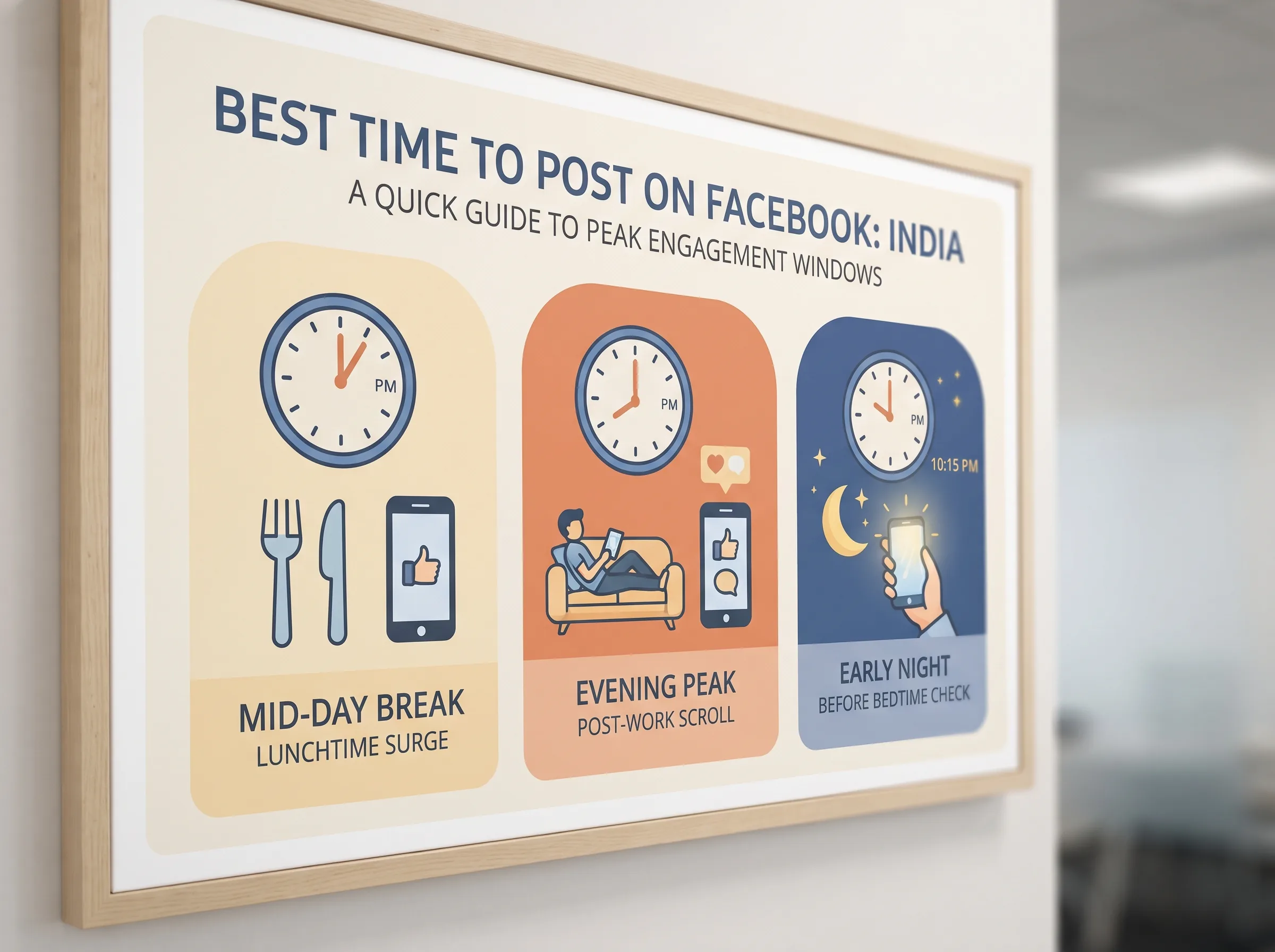
Every study above was built mostly on US and global-timezone data. If you're running the Facebook Page for a salon in Bangalore or a manufacturing unit in Surat selling to Flipkart and Amazon.in buyers, the Sprout and Buffer windows are a reasonable place to start in week one, but your actual followers, and their time zone and daily routine, are what decide your real numbers.
Here's how to find your best time to post on Facebook for business in under five minutes, and how to get a proper read on it within a week:
- Open the Facebook app for your Page (or Meta Business Suite on desktop) and make sure it's set up as a Business Page, not a personal profile.
- Go to Meta Business Suite, tap Insights, then Audience.
- Scroll to Most Active Times, which shows exactly when your followers are online, broken down by hour and day.
- If your Page is new or the data looks thin, run a 7-day test: post three times a day for a week, one in the morning, one in the afternoon, one in the evening, at consistent slots. One creator running Facebook Lives for her own business found her actual peak, a fixed Tuesday 8 PM slot, purely by testing different times and reading her analytics afterward, not by copying a published study.
- After a week, compare the three time-of-day slots against each other in your Insights, and lock in whichever one performed best, then keep testing new candidate hours around it.
For most local Indian businesses running their own Page, this individualized read tends to land close to the Sprout or Buffer windows converted into IST, a late-morning slot for audiences checking Facebook during a work break, or an early-evening slot for people scrolling after they get home. "Close to" isn't "identical to," which is exactly why the five-minute check above beats copying either study wholesale.
A 5-minute Meta Business Suite check
If you only have five minutes right now and no time for a week-long test, do just step 2 through step 4 above. Most established Pages already have enough data in Most Active Times to give you a usable answer today, without waiting a week.
Does the day matter more than the hour on Facebook?
Across both Sprout and Buffer's data, the day of the week carries at least as much weight as the exact hour, arguably more. A decent hour on a strong weekday consistently beats a great hour on a dead day. If you're deciding what to do with today's post and don't have five minutes to check Insights, the fastest useful decision isn't finding the perfect hour, it's checking whether today is a weekday. If it is, almost any reasonable midday-to-afternoon slot beats a perfectly-timed Saturday post.
This is the best day to post on Facebook question in disguise, and it's easy to underweight because "best time" sounds like an hour problem by default. But think about what's actually happening on a weekday versus a weekend. Weekday scrolling is broken into small, frequent check-ins around work, commutes, and lunch breaks, which is exactly the kind of quick-glance behavior that rewards a well-timed post showing up in the feed. Weekend scrolling tends to be longer but far less frequent, and more filled with content from close friends and family than new Pages being discovered. A boutique in Jaipur posting a festive collection at a perfectly-timed 5 PM Saturday slot is still fighting a quieter, less discovery-friendly feed than the same post at an average Tuesday afternoon.
Turning this into an actual posting habit
Knowing your window solves half the problem. The other half, the one that actually derails most small business Pages, is having something ready to post into that window when it arrives. It's easy to know Tuesday 1 PM is your slot and still miss it because the photo isn't edited, the caption isn't written, or nothing was planned for that day at all.
That's a content pipeline problem more than a timing problem, and it's worth solving on its own. If you're already juggling walk-in customers with a phone full of unedited product shots, the fix isn't a more precise posting-time chart, it's a running list of content ideas you can pull from in under a minute, and a way to actually queue posts so your best window doesn't depend on you remembering it in real time between customers.
Scalio turns a product photo and a short brand brief into model-wearing photos and Reels in minutes, and includes a content calendar so you always have something ready to drop into your best Facebook window, instead of scrambling. It replaces the shoot, the studio, and the agency retainer, from ₹999/month against a ₹10K+/month agency. See how it works →
If your brand is already active on Instagram, the same timing logic carries over almost exactly, with its own separate data. Our best time to post on Instagram guide covers the Instagram-specific windows and Adam Mosseri's own advice on posting just before your audience peaks.
Frequently Asked Questions
What is the single best time to post on Facebook?
There's no single universal time. Sprout Social points to Tuesday and Wednesday, 12–8 PM as its strongest window, while Buffer points to Thursday at 9 AM based on a separate 14-million-post dataset. Both agree weekdays beat weekends by a wide margin. Your own Facebook Page Insights will tell you which of the two patterns your actual audience follows.
What is the best time to post on Facebook for a business page specifically?
Business Pages should treat the Sprout and Buffer windows as a week-one benchmark, then check Meta Business Suite's Insights, under Audience, then Most Active Times, to see when your specific followers are online. A local retail Page and a B2B services Page can have very different peak hours even in the same city, so the aggregate number is a starting point, not the final answer.
What is the worst time to post on Facebook?
Weekends. Both the Sprout Social and Buffer datasets show Saturday and Sunday posting the lowest engagement of the week across nearly every industry. Late night performs weakly in both studies too. If you only fix one habit, stop treating Saturday and Sunday as your primary posting days.
How do I find the best time to post on Facebook for my specific page?
Open Meta Business Suite, go to Insights, then Audience, then Most Active Times, to see exactly when your followers are online by hour and day. If that data looks thin, run a 7-day test posting three times a day at fixed morning, afternoon, and evening slots, then compare which slot performed best in your Insights afterward.
Does the best time to post on Facebook change for Indian audiences specifically?
The published studies lean US and global-timezone weighted, so treat the Sprout and Buffer windows as a starting benchmark converted into IST, not a fixed answer, for an Indian audience. A salon in Bangalore or a manufacturer in Surat should verify against their own Page Insights, since local habits like lunch-break scrolling or evening family time can shift the real window earlier or later than the global average suggests.