
A garment exporter in Surat has four apps open on a Tuesday morning: one removes photo backgrounds, one schedules Instagram posts, one promised to "run his ads with AI," and one chatbot he signed up for and never configured. He needed one thing today, catalogue photos for a new lawn collection, and none of the four do that job. That's the real problem with AI marketing tools: not that they don't work, but that the phrase covers five different jobs, and most people shop for one tool that claims to do all five.
TL;DR
- AI marketing tools split into 5 distinct jobs: content creation, scheduling, ad creative, analytics, and customer chat.
- No single tool does all five well. Match the tool to your actual bottleneck, not the longest feature list.
- India-specific: WhatsApp Business AI (Meta, May 2026) now handles customer chat in native Indian languages, no-code, free-to-set-up.
- Ad platforms like Meta Advantage+ need real spend and conversion volume to work. Content tools don't.
- Start with one tool that fixes your single biggest gap, add a second only once it's paying for itself.
Here's the honest breakdown: what each job needs, which real tools are built for it, what they cost, and the tradeoffs, so picking a tool takes ten minutes instead of ten open tabs.
Why "AI marketing tools" stopped meaning one thing
Key definition: AI marketing tools are software products that use AI to generate, plan, or optimize one specific marketing job, content creation, scheduling, ad creative, analytics, or customer chat, rather than a single tool that does all five.
Three years ago, an AI marketing tool meant a chatbot that wrote your captions. Today the category covers everything from generating product photos to running an ad campaign's targeting decisions. That's a real expansion, and it's why "best ai marketing tools" listicles are mostly useless: they rank forty tools on one table as if a photo generator and an ad-bidding engine compete for the same job. They don't.
The instinct is to search, find a "best AI marketing tools" list, and pick whatever's ranked first. But most lists assume you already have product photos, a copywriter, and an ad budget ready to plug in. A salon owner in Bangalore or a kurti seller on Meesho usually has none of that lined up yet. The real question isn't which tool is best. It's which job is actually stalling you.
This piece is scoped wider than social media alone (see our breakdown of AI tools for social content for that narrower question). Here we're covering the full stack: what makes the content, what runs the ads, what shows if it worked, and what talks to customers when you're offline.
The 5 jobs AI marketing tools actually do
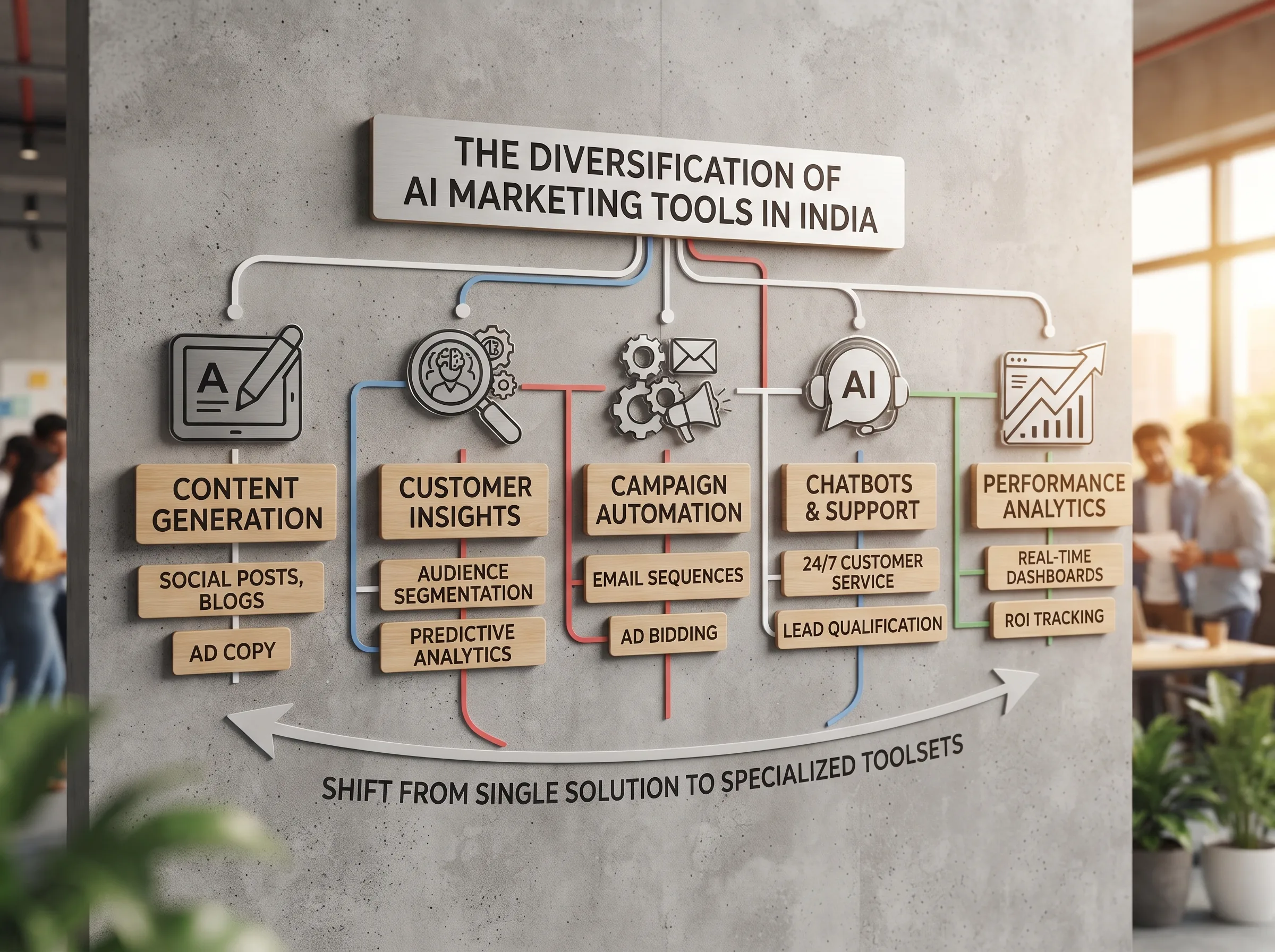
Strip the branding away and almost every tool falls into one of these:
- Content creation, product photos, model shots, graphics, video, Reels
- Scheduling and calendars, queues posts, suggests times, fills a content plan
- Ad creative and ad management, generates ad assets, targets audiences, optimizes spend
- Analytics and insights, tells you what's working and what isn't
- Customer service and chat, answers customer questions automatically, day and night
A business with a real stack usually pulls from two or three of these. A business just starting out usually has budget for one. Knowing which bucket a tool sits in stops you buying a scheduler when the real problem is nothing worth scheduling.
| Job | What it solves | Example tools | Typical monthly cost |
|---|---|---|---|
| Content creation | You have nothing worth posting | Canva, Photoroom, Scalio | Free to ₹2,000 |
| Scheduling and calendars | Content exists but posting is inconsistent | Buffer, Later, Hootsuite | Free to $199 |
| Ad creative and management | Organic works, ready to test paid | Meta Advantage+, Google Performance Max | Free platform, $1,000+ ad spend |
| Analytics and insights | Posting consistently, unsure what's working | Meta Business Suite, Improvado, GA4 | Free to team-tier pricing |
| Customer service and chat | Customers message faster than you can reply | WhatsApp Business AI, Tidio, Intercom Fin | Free to per-seat pricing |
Key insight: The fastest way to waste money on AI marketing tools is buying one before naming the actual bottleneck, content, scheduling, ads, analytics, or chat, and picking the single tool built for that job.
AI tools for content creation
This is the most upstream job: you don't have anything to post yet. Canva's Magic Studio suite runs about $12.99/month on its Pro plan and lets a non-designer type a prompt and get an editable graphic pulled from a saved brand kit, a strong general-purpose pick for posters, quote cards, and resized designs across platforms. Photoroom is built for product photography specifically, background removal, cutouts, marketplace-ready templates, and the company says it processes more than 100 million product images a month.
Scalio sits in this bucket too, for the step neither tool does: putting your actual product on an actual-looking model, without booking a photographer or sourcing stock images. It takes one product photo and your brand context and returns model-wearing photos and Reels, the step that would normally mean a studio booking in Surat and a week's wait for the shoot.
Where Scalio fits vs Canva and Photoroom
Canva is general design, anything with a template. Photoroom is product-photo cleanup, for a listing photo that already exists and needs a clean background or marketplace crop. Scalio is model-wearing content from a single product shot, closer to replacing a photoshoot than editing an image. A saree seller on Meesho doing catalogue cleanup reaches for Photoroom. A brand that needs a model wearing the outfit for a Reel reaches for Scalio's AI photoshoot tool or Reel maker. Fashion brands can see this on Scalio's fashion photography page, and Amazon or Flipkart sellers managing large catalogues can check Scalio's Amazon catalogue tool.
AI tools for scheduling and content calendars
Once there's something to post, the next job is going out consistently instead of in bursts of five and then silence for two weeks. Buffer prices per connected channel rather than per user, a usable free tier plus paid plans from about $5/channel/month on Essentials, which suits a solo owner or two-person team. Later runs around $18.75 to $25/month annually and leans visual-first, useful for previewing an Instagram grid before it's live. Hootsuite's Standard tier now starts at $99/month annually for up to 10 accounts, with Professional at $199/month for unlimited accounts, aimed at teams managing multiple brands rather than a single small business.
The tradeoff: the "AI" in a scheduler is mostly optimal-posting-time detection and light caption assist, not content creation. You're paying for the queue, not for the tool to invent what to post. If Hootsuite feels like more than a single shop needs, there's a lighter breakdown of alternatives, and a fuller comparison of scheduling tools by price and features is worth reading before an annual plan.
AI tools for ad creative and ad management
This bucket covers tools that build or optimize paid ads, not organic posts. Meta's Advantage+ is free inside Ads Manager, and advertisers running it have seen a 32% decrease in cost per acquisition and a 22% average lift in ROAS, with Meta lowering the minimum conversion threshold to as few as 25 a week for Shopping campaigns in 2026, opening it to smaller advertisers who couldn't generate enough data before. Google's Performance Max works similarly, handing targeting and creative rotation to the platform's own optimization.
The catch: these tools need real, ongoing ad spend and conversion volume, generally $1,000 to $3,000/month for reliable results per the same reporting. Not a fit for a business that hasn't started paid advertising yet. What these platforms don't do is make the ad creative itself look good before it goes into rotation. That's where Scalio's AI ad maker and festival ads pack come in, generating the images and video that feed into Advantage+ or Performance Max. Ads are a later-stage spend; a shop that hasn't nailed organic content yet usually gets more value fixing that first.
AI tools for analytics and performance insights
Once you're posting and maybe running ads, the next question is whether any of it is working. Meta Business Suite's native insights are free and cover the basics: reach, engagement, which posts landed. That's the right starting point before paying for anything dedicated. Tools like Improvado layer AI on top for teams that want plain-English queries against unified data instead of spreadsheets, and Google Analytics 4's AI Insights add predictive audiences for businesses running paid campaigns across channels.
For most small businesses, free native insights answer most of the real question before a paid layer earns its subscription. If timing specifically is your question, the data on best posting times answers that directly.
AI tools for customer service and chat
This is the job most "AI marketing tools" roundups skip, and it's the one with the most genuinely new development for Indian businesses this year. Meta rolled out Business AI on WhatsApp for small businesses in India in May 2026, letting a business answer customer questions 24/7 in native Indian languages, no coding required, trained on its own product and pricing information. That matters because messaging is already how Indian customers reach businesses: 91% of online adults in India chat with a business weekly, per a 2025 Kantar study cited in Meta's own announcement. A salon in Bangalore fielding the same five WhatsApp questions about appointment slots and pricing every evening is exactly who this was built for.
Outside WhatsApp, general-purpose tools like Tidio, Intercom's Fin, and Freshdesk's Freddy do the same job across chat and email, useful if customers aren't concentrated on one app. Scalio doesn't do this job, and it's better to say so than stretch a content tool into a support pitch it can't deliver.
How to actually pick, without stacking five subscriptions
Name your actual bottleneck before opening a pricing page. Nothing worth posting, start with content creation, no scheduler fixes an empty content folder. Photos but bursty posting, a scheduler's free tier closes that gap in an afternoon. Organic working with budget to test paid, that's when ad platforms earn the setup time. Customers messaging faster than you can reply, that's a chat tool's job specifically.
A boutique owner in Jaipur running this in practice: one product photo turned into a week of Reels through Scalio, dropped into Buffer's free scheduler, WhatsApp Business AI answering "is this available in my size" overnight. Three tools, three jobs, no agency retainer.
Turn AI tools into a system, not five tabs
No single AI marketing tool replaces a photographer, scheduler, ad manager, and support team at once, and any tool claiming to is overselling three of those four. Pick the job costing you the most time and start there.
Scalio turns a product photo and brand context into model-wearing photos and Reels in minutes, replacing the shoot, studio, and agency retainer, from ₹999/month for 100 credits against a ₹10,000-50,000/month agency. It solves the content-creation job, paired well with Scalio's social media calendar and post maker once the photos exist. See how it works →
Frequently Asked Questions
What's the difference between AI marketing tools and marketing automation?
Marketing automation usually means rule-based workflows, sending an email when someone abandons a cart, for example. AI marketing tools generate or optimize the content and decisions themselves: writing copy, creating images, deciding who to target. Some platforms do both, but the terms aren't interchangeable.
Do I need a different AI tool for every marketing job?
Not necessarily. Most small businesses start with the single biggest bottleneck, usually content creation without an in-house photographer, and add a scheduler only once that first tool is paying for itself. Five subscriptions from day one rarely earns its cost for a single-location business.
Can WhatsApp AI actually handle customer queries for a small Indian business?
Yes. Meta's Business AI on WhatsApp launched for small businesses in India in May 2026, answering questions about products, pricing, and shipping in native Indian languages, around the clock, without requiring code or a third-party platform to set up.
What should a small Indian business budget for AI marketing tools?
It depends on the job. Content-generation tools built for SMBs typically run ₹999 to ₹2,000 a month. Scheduling tools have workable free tiers for a single account. Ad platforms need real spend, generally upwards of ₹80,000 to ₹2,50,000 a month, before there's enough conversion data for their AI to optimize against, according to reporting on Meta Advantage+'s minimum data requirements.
Can AI marketing tools fully replace a marketing agency?
For a single-location business without complex paid-media needs, two well-matched tools, content generation plus a scheduler, cover most of what a small agency retainer handles: content, a posting calendar, and basic consistency. Agencies still add value on strategy and paid-media at a scale most small businesses haven't reached.