

Hootsuite alternative: the short answer
TL;DR
- Hootsuite's Standard plan starts at $99/user/month billed annually, and it discontinued its free plan back in March 2023.
- Buffer, Later, and Sprout Social are all cheaper-to-comparable scheduling swaps, but every one of them is still just a scheduler.
- The real bottleneck for most small businesses isn't which app posts the content, it's having content ready to post.
- Scalio bundles the content creation (product photos, model shots, Reels) with the calendar, from ₹999/month against a ₹10K+/month agency retainer.
Key definition: A Hootsuite alternative is a social media scheduling tool that publishes and organizes posts across platforms like Hootsuite does, at a different price point or with different features, though most alternatives, like Hootsuite itself, still only handle scheduling and not content creation.
If you're searching for a Hootsuite alternative, chances are you're staring at a $99/month bill and wondering why a scheduling app for your one-person salon or boutique costs more than your electricity. That's a fair question, and the honest answer is: Hootsuite was built for marketing teams managing a dozen accounts, not for a single owner posting a few times a week between appointments.
This isn't a "Hootsuite is bad" post. It's a genuinely useful tool if you're running social for a big team. But most small business owners looking for an alternative aren't trying to replace a feature, they're trying to fix a budget problem, a complexity problem, or a "I don't even have anything to post today" problem. We'll walk through all three.

Direct answer: There is no single best Hootsuite alternative for everyone. Buffer and Later are the cheaper scheduling-only swaps; Sprout Social is the enterprise-scale option; Scalio is the option for a small business that needs the content made, not just scheduled.
Why small business owners look for a Hootsuite alternative
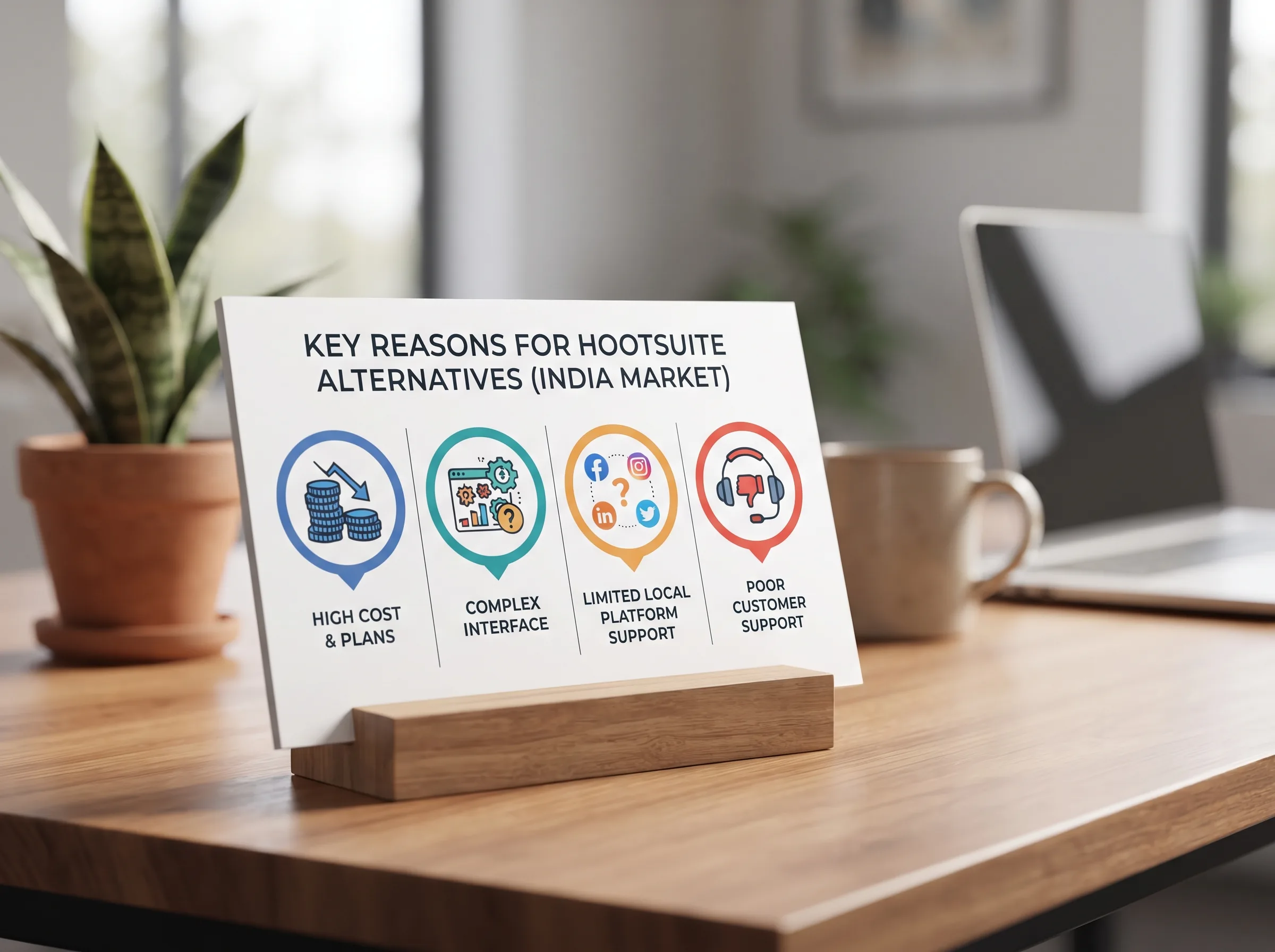
Three reasons keep showing up when you dig into why people actually switch off Hootsuite: the price, the clutter, and the fact that switching still doesn't fix the real problem.
The pricing problem
Hootsuite's Standard plan starts at $99 per user per month, billed annually, which works out to $1,188 upfront for the year. It didn't always cost this much to get started. Hootsuite discontinued its free plan on March 31, 2023, and existing free users were pushed onto the paid Standard tier. For a business in the US, that's a real line item. For a salon in Bangalore or a boutique in Jaipur working off a monthly marketing budget that might be a few thousand rupees, $99/month before any forex card markup isn't a tool decision, it's a non-starter.
The complexity problem
The other complaint that comes up again and again from people who've actually used Hootsuite day to day: it tries to do everything at once. Planning, analytics, a unified inbox, monitoring, all in one dashboard. That's genuinely valuable if you're an agency managing ten client accounts and need all of it. If you're posting three times a week for your own single-location business, most of that dashboard is dead weight you're paying for and never opening.
One creator reviewing scheduling tools put it simply: Hootsuite has a lot of features that are genuinely great, but there's almost too much going on for a single person trying to manage one brand's posting. You open the app to schedule one Reel and end up staring at analytics tabs, inbox notifications, and monitoring streams you never asked for. For a salon owner squeezing in social media between clients, that's friction, not a feature.
The switching-cost problem
There's a third, quieter reason people stay on Hootsuite even when they're unhappy: inertia. As one video comparing scheduling tools framed it, small businesses often keep paying for the well-known brand not because it's the best fit, but because switching feels like more effort than it's worth. That math changes fast once you add up what $99/month costs over a year against a better-fitting tool.
Hootsuite alternatives compared: features and pricing
Here's the honest version of the comparison, pulled from each tool's own published pricing, not marketing copy.
| Tool | Best for | Starting price | Content creation included? |
|---|---|---|---|
| Hootsuite | Larger teams needing full analytics + inbox | $99/user/month (no free plan) | No, scheduling only |
| Buffer | Solo creators, straightforward scheduling | Free plan available, paid from $6/channel/month | No, scheduling only |
| Later | Visual-first Instagram planning | From $25/user/month | No, scheduling only |
| Sprout Social | Enterprise teams, CRM + social listening | From $199/user/month | No, scheduling only |
| Scalio | Solo owners who need photos, Reels, and a calendar | From ₹999/month (100 credits) | Yes, AI photoshoot + Reels + calendar in one |
Read that last column again. Every scheduling tool on this list, Hootsuite included, assumes you're arriving with content already made. None of them help you make the actual post. That's not a knock on any of these tools, it's just not what they're built to do. Scalio is built to do the opposite job: give you the content first, then the calendar to put it on.
Key insight: Cheaper scheduling isn't the same as solved content. Nearly every Hootsuite alternative on the market competes on price and dashboard polish while leaving the actual content-creation gap untouched, which is why switching tools alone rarely fixes an empty content calendar.
If you're choosing between scheduling tools specifically, hootsuite vs buffer comes down to budget and simplicity. Buffer wins on price and ease of use for a solo operator. Hootsuite wins if you genuinely need the deeper analytics and multi-seat approval workflows of a bigger team.
What Hootsuite alternatives still don't solve
This is the part that most "best Hootsuite alternatives" roundups skip entirely. Swap Hootsuite for Buffer, Later, or any other scheduler, and you've solved exactly one problem: where the post gets scheduled from. You haven't solved the problem that actually eats most small business owners' weeks, which is getting from "empty content calendar" to "photo or Reel ready to publish."
Think about what a typical week looks like for a boutique owner in Surat or a salon owner in Bangalore. New stock or a new service comes in on Monday. The photographer they usually use is booked until Thursday, or costs more than they want to spend for a few product shots. By the time photos exist, the trending moment or the "new arrival" urgency has already passed. It doesn't matter whether the scheduling app is Hootsuite or the cheapest alternative on the market, if there's nothing to post, the calendar sits empty regardless of which tool's logo is in the corner.
That's the actual gap between "a cheaper scheduler" and "a tool that fixes the whole pipeline."
A week in the life of a small business without a content calendar
Here's what that week tends to look like for a lot of salon and boutique owners we talk to, not any one specific business, just the pattern that repeats:
Monday, new stock arrives and there's no time to shoot it. Tuesday, a client cancels and there's a free hour, but no camera, no lighting, no model. Wednesday, someone finally takes a few phone photos between appointments, but they don't look good enough to post next to a competitor's polished Reel. Thursday, the photographer they usually call is booked for two weeks. By Friday, the "new arrival" post that should have gone up Monday still hasn't happened, and next week's stock is already arriving.
None of that week was solved by which scheduling app was open in another tab. The bottleneck was upstream of scheduling entirely.
What to actually look for in a Hootsuite alternative
Most comparison lists rank alternatives by feature count. That's the wrong scorecard for a small business. Here's what actually matters, in order:
- Fit your posting volume, not a marketing team's. Posting three to five times a week doesn't need enterprise analytics or social listening. Pick a social media scheduler sized for your actual output.
- Check whether pricing is per-channel or per-seat. "From $6/channel/month" sounds cheap until you're running four channels. Add it up before comparing headline prices.
- Ask if it helps with the content itself, or only the posting of it. This is the question most roundups skip, and the one that decides whether switching actually fixes your week.
- Try before you commit annually. Most tools in the table above offer a free plan or trial period.
Switching from Hootsuite: what to check before you commit
Before you move off Hootsuite to anything else, a few practical things to check first:
- Your connected accounts. Most tools require you to reconnect each social account manually, budget 20-30 minutes for this.
- Existing scheduled posts. There's no universal one-click migration between platforms, you'll likely need to rebuild your queue in the new tool.
- Team seats and approvals. If more than one person posts, confirm the new plan actually includes multi-user access at the price you're comparing.
- Whether content creation is included or not. This is the question the comparison table above answers, and it's the one most people forget to ask until they've already switched and hit the same empty-calendar problem again.
Where Scalio fits if you're switching off Hootsuite
If the actual reason you're hunting for a Hootsuite alternative is "I can't keep this calendar full," a cheaper scheduler alone won't fix it. Scalio turns a product photo and a short brand brief into model-wearing photos and Reels in minutes, and pairs it with a content calendar so there's always something ready to post into your slot, instead of scrambling on a Monday with no photos and a client waiting. It replaces the shoot, the studio, and the agency retainer, from ₹999/month against a ₹10K+/month agency.
Once you've got content flowing, timing is the next lever worth pulling, our guide on the best time to post on Instagram breaks down when to actually publish once you're not scrambling to have anything ready. See how Scalio works →
Frequently Asked Questions
What is the cheapest Hootsuite alternative?
Buffer's free plan, with paid tiers starting from $6/channel/month, is the cheapest scheduling-only option on the market. If you also need the content itself made, not just scheduled, Scalio's ₹999/month plan covers photoshoot, Reels, and scheduling together, which usually works out cheaper than paying for a scheduler and a separate photographer.
Why did Hootsuite remove its free plan?
Hootsuite discontinued its free plan on March 31, 2023, moving existing free users onto the paid Standard tier starting at $99/month. It hasn't reinstated a free tier since.
Is Buffer or Later a better Hootsuite alternative for small business?
Buffer suits straightforward multi-platform scheduling on a tight budget and is the simpler of the two to set up. Later is built around Instagram-first visual grid planning, which suits accounts that lean heavily on aesthetic feed layout. Neither includes AI content generation, so switching to either one still leaves the content-creation gap open.
Do I need a scheduling tool if I only post a few times a week?
A free or cheap scheduler is genuinely enough if volume is your only constraint. For most low-frequency posters, the bigger win isn't a better scheduler, it's having ready content on hand, which is where a content calendar paired with an AI photoshoot tool like Scalio helps more than swapping one scheduling app for another.
Can I switch from Hootsuite without losing my scheduled content?
Most alternatives don't offer a universal one-click migration. You'll need to manually reconnect your social accounts and rebuild your posting queue in the new tool. Budget a short setup window, generally under an hour for a single-location business, before your old Hootsuite plan expires.