
TL;DR AI product photography helps Indian sellers create better listing images faster and cheaper. It cuts costs from Rs. 500–2,000 per image to around Rs. 10–30 per image. It is most useful for fashion, lifestyle images, backgrounds, and bulk catalog editing. Tier 2/3 sellers benefit because they can avoid expensive metro studios. Best results come from real, clear product photos — not fully AI-generated images.
1. The Indian Ecommerce Landscape in 2026
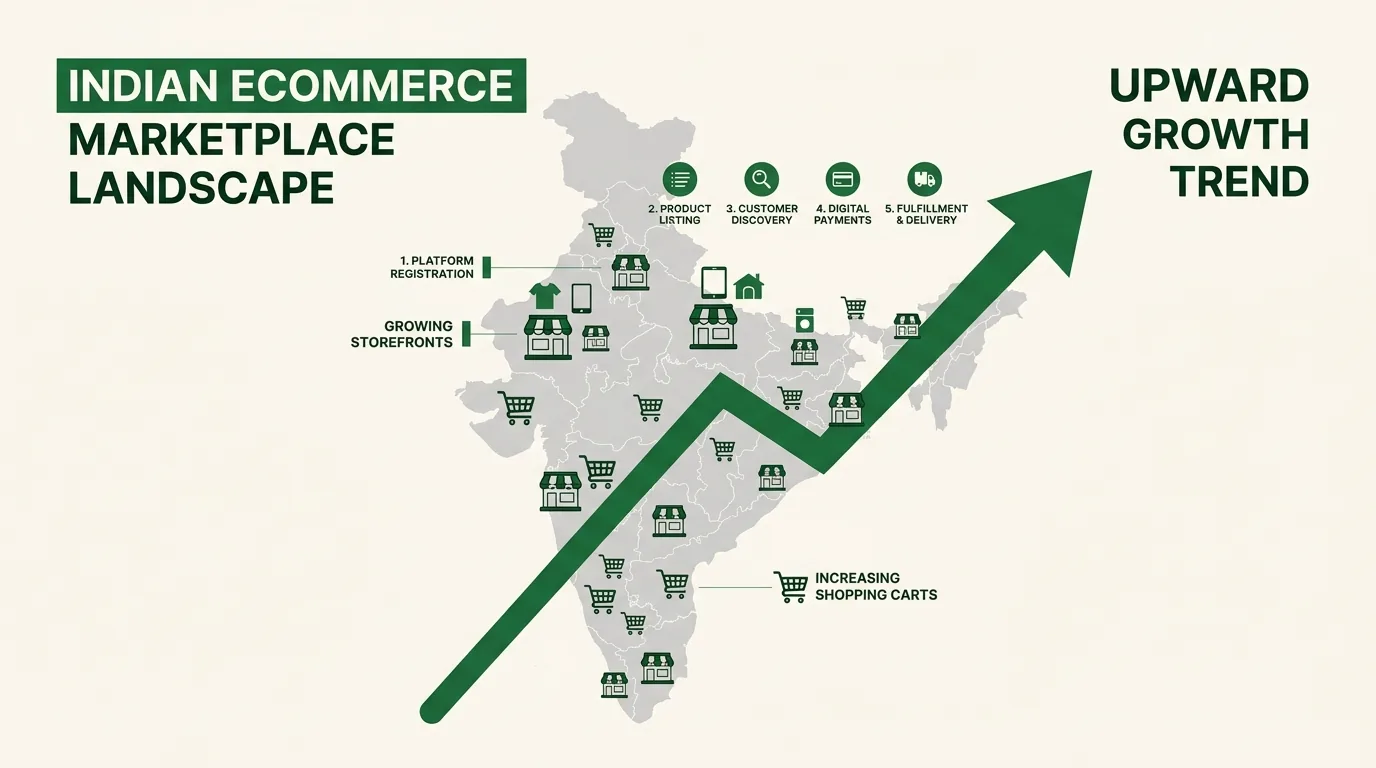
Understanding the scale and structure of Indian ecommerce is essential context for any analysis of product photography trends — because product images are not a standalone concern, they are a direct input to conversion performance on every one of these platforms.
India ecommerce GMV in 2025 reached $65–66B (IBEF / Bain and Company). There are 3.5M+ active sellers across Indian marketplaces (IBEF / tapwell.in). The sector is growing at a 19–21% CAGR (IBEF Industry Analysis 2026).
| Platform | 2025 Position | Key Metric | Relevance for AI Photography |
|---|---|---|---|
| Flipkart | India's #1 marketplace by GMV and delivery scale | Reported $24.8B online revenue in 2025 (ECDB); Ekart logistics in 400+ cities | Strict image compliance required; fashion and home goods dominant — both high-image-sensitivity categories. |
| Amazon India | #2 by GMV; premium urban focus | AI-powered photography enhancement tools for third-party sellers launched | Strictest image requirements in Indian ecommerce; pure white background enforced automatically; AI image editing officially recognised. |
| Myntra | India's dominant fashion marketplace | FY25 revenue Rs. 6,042.7 crore, profit Rs. 548 crore; Rising Stars zero-commission program launched March 2025 | On-model imagery mandatory for most fashion categories — significant cost driver for small fashion sellers. |
| Meesho | Fastest-growing by shipment volume | 213M annual transacting users FY25 (Redseer); 87.8% outside top 8 cities; 19,000+ pin codes | Seller quality standards tightening in 2025–2026; image quality increasingly a listing rank factor. |
| Nykaa | Dominant in beauty and personal care | BPC projected to reach $30B GMV by CY27 (IBEF); growing at ~10% CAGR | Beauty product photography requires colour accuracy above all else — AI colour consistency tools highly relevant. |
| AJIO | Reliance-backed fashion challenger; exclusive and indie label focus | Hyperlocal AJIO Rush service achieving 50–60% higher bill values for premium fashion orders (Reliance Retail, Jan 2025) | Premium fashion positioning requires higher-quality lifestyle imagery — AI lifestyle generation closing cost gap vs traditional. |
2. Why Product Photography Is a Structural Problem for Indian Sellers
India has approximately 60 million MSMEs (McKinsey MSME survey, November 2025) and over 3.5 million active sellers on ecommerce platforms. The overwhelming majority cannot absorb the per-image cost structure of traditional product photography — yet they are competing on the same listing pages as brands that can, a gap our ecommerce product photography guide breaks down in detail.
AI product photography brings the cost per image down to Rs. 10–30 for standard catalog shots, versus Rs. 500–2,000 per image with traditional studio photography (all-in estimate).
Note: Cost figures are all-in practitioner estimates for Delhi NCR, Mumbai, and Bengaluru markets. Costs vary by city, category, volume, and studio. Traditional photography costs include studio rental, photographer day rate, styling, and retouching.
The cost gap is not the only problem. The speed gap is equally significant. Traditional studio photography for a 100-SKU catalog typically takes 2–4 weeks from booking to final delivery: studio scheduling, shipping samples, shoot day, retouching, delivery. AI tools deliver the same output in hours. For D2C brands in fashion and beauty — categories where new collections drop monthly — the lag between product creation and listing readiness is a direct constraint on growth velocity.
| Pain Point | Traditional Photography | AI Photography | India-Specific Context |
|---|---|---|---|
| Cost per image | Rs. 500–2,000 (all-in estimate) | Rs. 10–30 for standard catalog | SMBs and Meesho sellers operating on Rs. 200–500 average order values cannot justify high per-image costs. |
| Time to catalog | 2–4 weeks (shoot + retouch + delivery) | Hours (same-day for white background; 24–48h for lifestyle) | Fast fashion and seasonal drops (Diwali, Holi, Eid) require rapid catalog updates that traditional timelines cannot support. |
| Scale | Limited by studio booking and sample logistics | Unlimited (bulk processing from single shoot) | Sellers managing 500–5,000+ SKUs face exponential costs at traditional rates. |
| On-model imagery (fashion) | Model fees (Rs. 2,000–10,000/day estimate) + studio + styling | AI model generation from flat-lay or mannequin images | Myntra and Ajio require on-model imagery for fashion — compliance cost is a barrier for small apparel sellers. |
| Festive seasonal variants | Separate shoot required for each seasonal campaign | Background swap from single source image | Indian ecommerce has 12+ festive events per year; each traditionally requires a separate photography brief. |
| Geographic access | Studio quality restricted to metro cities (Delhi, Mumbai, Bengaluru) | Available to any seller with a smartphone and internet connection | 60%+ of new D2C consumers and sellers are in Tier 2/3 cities without access to professional photography studios. |
3. Fashion Ecommerce: The Highest-Stakes Photography Category in India
Indian fashion ecommerce is the single most image-sensitive product category in the market — and also the one where the photography cost burden falls hardest on small sellers, which is exactly where AI fashion photography has the largest impact.
India's online fashion retail market is growing at 21.1% CAGR from 2025–2030 (Technavio Market Research). Online fashion return rates for apparel run at 25–30% (industry data). Myntra reported FY25 revenue of Rs. 6,042.7 crore with profit of Rs. 548 crore.
The causal link between product image quality and return rate in fashion is well-established. Chrimes, Boardman, Vignali, and McCormick (2022, Journal of Consumer Behaviour) found that the number and type of product images, along with zoom functionality, significantly affect how accurately consumers can judge clothing fit online. In a market where fashion returns run at 25–30%, improved imagery is not a cosmetic upgrade — it is a returns reduction mechanism with direct P&L impact.
| Platform | Fashion Photography Standard | Model Requirement | AI Photography Compliance |
|---|---|---|---|
| Myntra | Light grey background, 3:4 aspect ratio, minimum 1500x2000px; consistent skin tone across catalog | Required for apparel categories — 'model photos are the most effective for fashion listings' per Myntra guidelines | AI model generation is accepted where output accurately represents garments. Verify current policy with Myntra seller support before publishing at scale. |
| Amazon India | Pure white background (RGB 255,255,255) for main image; 85% frame fill; 1,000px minimum, 2,000px+ recommended | The model must be standing (not sitting, kneeling, lying). AI editing of real product photos permitted; purely AI-generated main images that misrepresent the product prohibited. | Background removal + placement on pure white accepted. AI lifestyle images in secondary slots accepted. Always start from a real product photograph. |
| Flipkart Fashion | White or light background for main listing; on-model preferred for apparel | On-model preferred but not always required — category-dependent | AI background generation and on-model generation both used by sellers. Verify category-specific requirements at Flipkart seller portal. |
| AJIO | Premium positioning requires higher-quality lifestyle imagery; editorial aesthetic expected for brand-tier products | On-model required for most fashion; editorial lifestyle for premium tier | AI lifestyle generation relevant for secondary imagery and campaign assets. Main listing on-model shot still required. |
| Meesho | Image quality standards tightening in 2025–26; basic requirements: clear product, recognisable image, no misleading imagery | Not currently required; plain product images accepted | AI white background generation is widely applicable. On-model not required — lower barrier for AI adoption. |
The on-model requirement is the highest-cost photography standard in Indian ecommerce. A Myntra-compliant fashion catalog of 100 SKUs traditionally requires a model for a full day (Rs. 5,000–15,000 minimum estimate), a photographer, a studio, and retouching — totalling Rs. 50,000–2,00,000+ for 100 products. AI model generation — using a clean product photo as input and generating a realistic AI model wearing the garment — reduces this to Rs. 10–30 per image without a model booking or studio. The output quality, for standard fashion catalog use, is now sufficient for Myntra and Flipkart Fashion listing standards in most apparel categories.
4. Where Indian Sellers Are in the AI Photography Adoption Curve
AI product photography adoption in India is uneven — advanced among funded D2C brands, slower among the long tail of MSME sellers, and accelerating rapidly as platform-native AI tools reduce the technical barrier.
| Segment | Adoption Status in 2026 | Primary Drivers | Main Barriers Remaining |
|---|---|---|---|
| Funded D2C brands (Rs. 50Cr+ revenue) | Active adoption — AI used in content pipeline for lifestyle imagery, A/B testing, festive variants | Budget availability; speed-to-market pressure; in-house digital teams | Human oversight at scale; brand consistency management across large catalogs |
| Mid-market ecommerce sellers (Rs. 5–50Cr GMV) | Early majority — selectively adopting for specific use cases (background removal, festive campaigns) | ROI clarity from early adopters; platform tool availability (Amazon AI tools) | Workflow integration; quality consistency concerns; uncertainty about platform policy |
| Small sellers and MSMEs (Rs. 50L–5Cr GMV, Tier 1 cities) | Early adopter phase — 48% of Indian businesses in general have initiated GenAI PoCs (EY India 2025) | Cost savings compelling; free tiers on AI tools enabling experimentation | Technical confidence; understanding which tool for which use case |
| Tier 2/3 sellers (Meesho, budget platforms) | Laggards — majority still using phone photography or paying local photographers | Meesho's low barrier to entry means image quality less enforced historically | Smartphone as only device; limited internet bandwidth for large image uploads; Meesho tightening quality standards in 2025–26 will accelerate change |
| Fashion brands on Myntra / Ajio | Bifurcated — established brands using AI for lifestyle; SMBs struggling with on-model requirement cost | Myntra Rising Stars zero-commission program reducing barriers; Myntra itself providing photography guidance | On-model AI imagery acceptance by Myntra varies by category; quality bar for fashion is high |
48% of Indian businesses have initiated GenAI proofs of concept (EY India 'AIdea of India: 2025'). The projected productivity improvement in India's retail sector from GenAI over the next 5 years is 35–37% (EY India 2025). AI image editing software on G2 saw 441% YoY growth in 2024 (G2 Data).
Two platform-level developments are accelerating the adoption curve specifically for Indian sellers:
Amazon India announced AI-powered product photography enhancement tools as part of its seller support program — making AI photography a native platform feature rather than a third-party add-on. This significantly reduces the discovery and onboarding barrier for Amazon India sellers.
Myntra Rising Stars, launched March 2025, is a zero-commission program for emerging D2C labels that reduces the financial barrier to listing on Myntra — but also increases pressure on new sellers to meet Myntra's photography standards, which are among the most demanding in Indian ecommerce.
5. The Tier 2 and Tier 3 Opportunity: AI Photography as Equaliser
The fastest-growing part of India's ecommerce market is also the part most underserved by traditional photography infrastructure — and most directly empowered by AI photography tools.
66% of new D2C orders in FY26 came from Tier 2 and Tier 3 cities (Unicommerce / Whalesbook). 87.8% of Meesho's annual transacting users live outside India's top 8 cities (Redseer / India Dispatch). Meesho had 213M annual transacting users in FY25 (Redseer data).
Professional photography studios are heavily concentrated in metro India. Delhi NCR, Mumbai, and Bengaluru account for the vast majority of India's commercial photography infrastructure. A seller in Jaipur, Surat, Patna, or Coimbatore — cities with rapidly growing ecommerce seller bases — may have limited access to quality product photography even if they can afford it.
AI photography tools, by contrast, require only a smartphone with a decent camera and internet access. The workflow: photograph the product on a white or neutral background using any smartphone camera, upload to an AI tool, generate marketplace-ready images. The entire process runs on mobile and requires no studio, no professional equipment, no logistics for sample shipping, and no photographer scheduling.
What Tier 2/3 seller adoption looks like in practice:
A kurti seller in Surat photographs 20 new designs per week using a Rs. 15,000 Redmi phone on a white bedsheet. Previously, she sent physical samples to a Delhi studio twice a month (Rs. 2,000+ shipping, 10-day turnaround). With Scalio, she uploads directly and gets marketplace-ready images in 30 minutes. Time to listing went from 14 days to same-day. Cost per image went from Rs. 600 to Rs. 10.
A handicraft seller in Jodhpur could not afford lifestyle photography for festival campaigns. AI background generation now produces festival-context images (Diwali diyas, Holi colours, Eid backdrop) from a single plain product photo. He now runs seasonal campaigns on Instagram and Meesho for the first time.
A gift hamper seller in Coimbatore used to ship physical samples to Bengaluru for photography before each new hamper configuration. With AI, he generates images from component photos without shipping — reducing time-to-listing by 12 days per product.
Try Scalio Free — AI Product Photography for Indian Ecommerce → — 5 free credits · Marketplace-ready images · No card required · Amazon, Flipkart, Myntra, Nykaa
6. What AI Product Photography Actually Does in 2026: A Capability Map
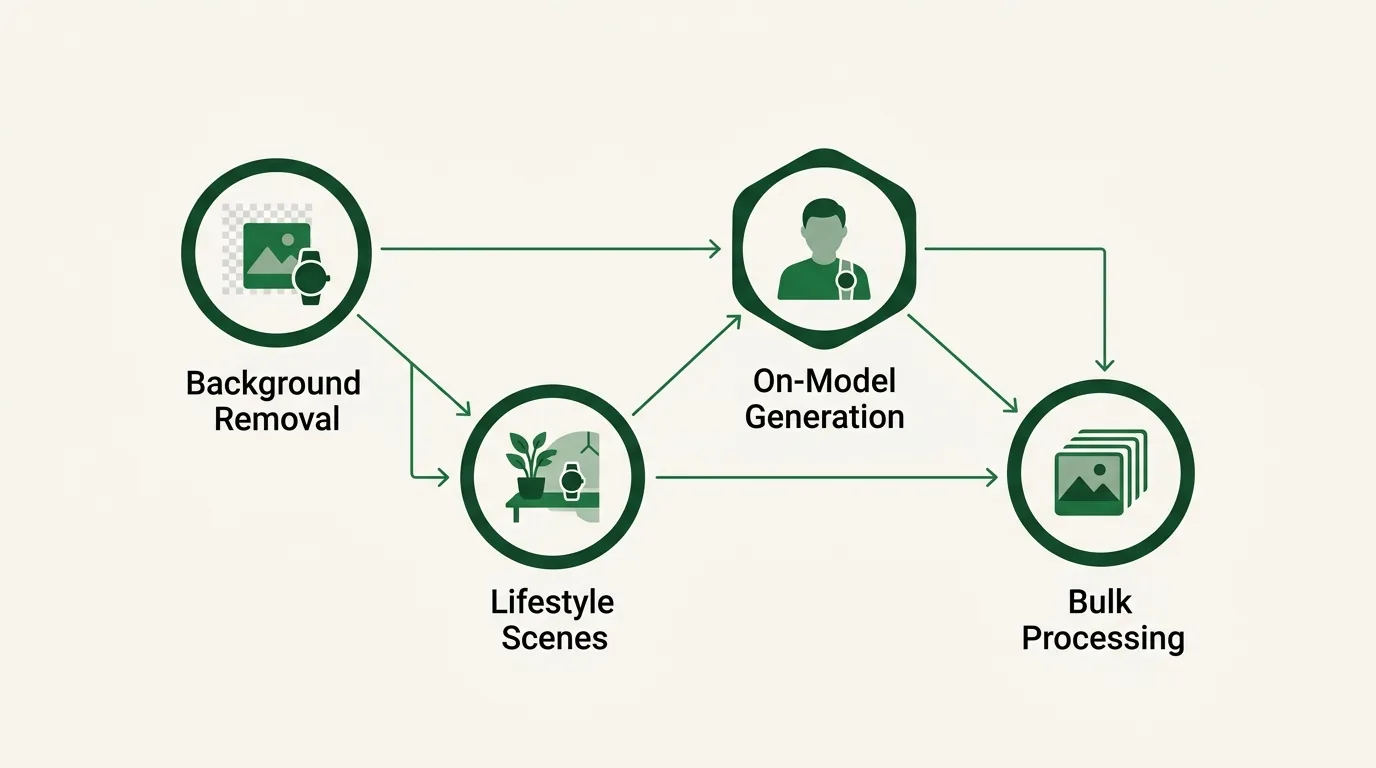
AI product photography is not a single tool. It is a set of capabilities that replace different parts of the traditional photography workflow. Understanding the distinct capabilities prevents the common mistake of selecting a tool built for one use case to solve a different problem.
| Capability | What It Does | India Use Case | Maturity in 2026 |
|---|---|---|---|
| Background removal | Removes background from product photo; isolates product on transparent or white canvas. | Every marketplace listing — pure white background for Amazon India, neutral grey for Myntra. | Fully mature — output quality indistinguishable from manual masking for most products. Challenges remain with complex edges (hair, sheer fabric, jewellery chains). |
| AI background generation (lifestyle) | Places product in a generated lifestyle scene: kitchen, living room, festival setting, outdoor environment. | Secondary listing images, social ads, campaign imagery, festive variants. | Mature for most product categories. Shadow/lighting mismatch with source photo is a known limitation. |
| On-model / fashion model generation | Generates AI model wearing the uploaded garment from flat-lay or mannequin source image. | Myntra and Flipkart Fashion compliance for small sellers who cannot afford model bookings. | Rapidly maturing — output quality now acceptable for standard fashion catalog. Premium fashion and detailed drape categories still benefit from real-model photography. |
| Bulk processing | Applies background removal, colour correction, and output formatting to hundreds of images in one batch. | Sellers managing 200+ SKU catalogs launching new collections regularly. | Fully mature and commercially deployed at scale. |
| Image upscaling / resolution enhancement | Increases image resolution from low-res source to marketplace-compliant dimensions. | Phone-camera product photos that don't meet marketplace minimum resolutions. | Mature for moderate upscaling. Risk of artefact introduction when upscaling aggressively from very low-quality sources. |
| UGC video ads from product images | Generates short-form video ads with AI actors, voiceover, and script from static product photos. | Instagram Reels, TikTok, Meta Ads — replacing video production cost. | Early commercial deployment. Quality sufficient for social ad use. Rapidly improving. |
| Festival / seasonal campaign imagery | Background swap to festive contexts (Diwali, Holi, Eid, Republic Day) from standard product photo. | Seasonal campaign imagery for all major Indian festival shopping events. | Mature — rapid background swap and scene generation well-established. |
7. What AI Product Photography Cannot Do: Honest Limitations
An honest assessment of AI product photography includes its current limitations — because overstating capability damages trust and leads sellers to deploy the wrong tools for the wrong products.
| Limitation | Impact | Mitigation |
|---|---|---|
| Cannot improve a poor source photo | Output quality is capped by input quality. A blurry, mixed-lit, low-resolution source photo produces a blurry, poorly-composed AI output. | Invest in basic source photography first: white/neutral background, good lighting, sharp focus. No AI tool compensates for a fundamentally poor source image. |
| Visual drift across catalog | Using the same prompt across different sessions produces different lighting, shadows, and colour temperatures. The catalog looks assembled from multiple photoshoots. | Use batch processing (all products in one session with locked parameters) and reference image-based style locking rather than text-prompt-only generation. |
| Text-to-image generates fictional products | Tools like Midjourney and DALL-E generate a plausible-looking product, not your actual product. Hallucinated details — wrong prong counts on jewellery, garbled label text — can trigger returns and listing issues. | Use image-to-image AI only for product listings. Text-to-image is appropriate for mood boards and concept work only. |
| Shadow and lighting mismatches | When the AI-generated background has a different light direction than the source product photo, the product appears 'pasted in'. | Review every generated image for shadow/light consistency. Specify matching light direction in prompts. Regenerate mismatches rather than publishing them. |
| Complex materials remain challenging | Sheer fabrics, multi-chain jewellery, highly reflective surfaces (metallic gift tins, glass products) may show artefacts at the product edge after background removal. | Use source photos with controlled lighting for these materials. For jewellery, ensure source macro captures chain and stone detail at resolution before AI processing. |
| Purely AI-generated main images prohibited on Amazon | Amazon explicitly prohibits main product images that are solely generated by AI and misrepresent the product. AI editing (background removal, scene placement) of real product photos is permitted. | Always start from a real product photograph. AI processes the background and scene — the product itself must always come from an actual photograph. |
8. Three Developments to Watch in 2026–2027
Based on current trajectory, three developments will have significant impact on AI product photography in India over the next 12–18 months.
Platform-Native AI Tools Will Reduce Third-Party Adoption Barriers
AI product photography is becoming a native platform service, not just a third-party add-on. Amazon India has already moved in this direction, and as Flipkart and Myntra follow, the discovery barrier for first-time AI photography adopters will reduce significantly. Sellers who learn the workflow now, before it becomes a default expectation, build a lead that compresses over time as adoption normalises.
On-Model AI Quality Will Reach Parity with Real Model Photography for Standard Fashion
AI model generation quality improved significantly in 2025 and is improving at pace. For standard ethnic wear and casual fashion categories on Myntra, Flipkart Fashion, and Meesho, AI model output quality is already approaching commercial-grade parity. The remaining gap is in premium fashion, detailed drape categories (sarees, heavy lehengas), and categories where exact fit representation is critical (stretch fabrics, structured garments). By late 2026 or early 2027, this gap is expected to narrow further — reducing the cost barrier for on-model compliance across the entire Indian fashion seller base.
ONDC Will Expand AI Photography Need to Previously Offline Sellers
The Open Network for Digital Commerce (ONDC) is bringing previously offline Indian sellers — kirana stores, local manufacturers, artisans — into the ecommerce ecosystem with significantly reduced platform fees and technical barriers. As ONDC adoption grows, hundreds of thousands of sellers new to ecommerce will face the product photography requirement for the first time. AI photography tools, with their low cost and smartphone-native workflow, are the most practical solution for this cohort — and the volume of new ONDC sellers entering the market represents a large underserved segment for platforms like Scalio.
9. Key Findings: State of AI Product Photography in India, 2026
| Finding | Data Point | Implication for Indian Sellers |
|---|---|---|
| India's ecommerce market is large, concentrated, and image-driven | $65–66B GMV in 2025; 3.5M+ sellers; Flipkart, Amazon, Myntra, Meesho dominant | Product image quality is a competitive variable on every one of these platforms. Poor images = lower search rank, higher returns, lower conversion. |
| AI photography tools have fundamentally changed the cost structure | Rs. 10–30 per image vs. Rs. 500–2,000 traditional (all-in estimate) | The cost barrier to professional-quality product images no longer exists for any Indian seller with a smartphone and internet access. |
| GenAI adoption is accelerating in Indian retail | 48% of Indian businesses have initiated GenAI PoCs; 32% have allocated budgets (EY India 2025) | Indian businesses are actively investing in AI — product photography is one of the most immediate ROI use cases. |
| Fashion is the highest-stakes category for image quality | 21.1% CAGR fashion ecommerce; 25–30% fashion return rates; Myntra on-model requirement | AI model generation directly addresses the highest-cost compliance requirement for Indian fashion sellers. |
| The growth is coming from Tier 2/3 cities — where AI solves access problems, not just cost | 66% of new D2C orders in FY26 from Tier 2/3; 87.8% of Meesho users outside top 8 cities | Traditional photography infrastructure doesn't reach where Indian ecommerce is growing fastest. AI photography does. |
| AI photography capabilities are real but bounded | Background removal and bulk processing fully mature; on-model maturing; lifestyle generation reliable; text-to-image inappropriate for listings | Image-to-image AI for all listing images. Human review before publication. Source photo quality sets the ceiling. |
| Platform compliance requirements are tightening | Amazon AI compliance detection more accurate; Meesho quality standards tightening; Myntra on-model standard enforced | Sellers investing in AI photography now are building compliance infrastructure ahead of the curve. |
Start with AI Product Photography on Scalio → — 5 free credits · Indian marketplace-native · Rs. 10/photo · Myntra, Amazon, Flipkart, Nykaa