
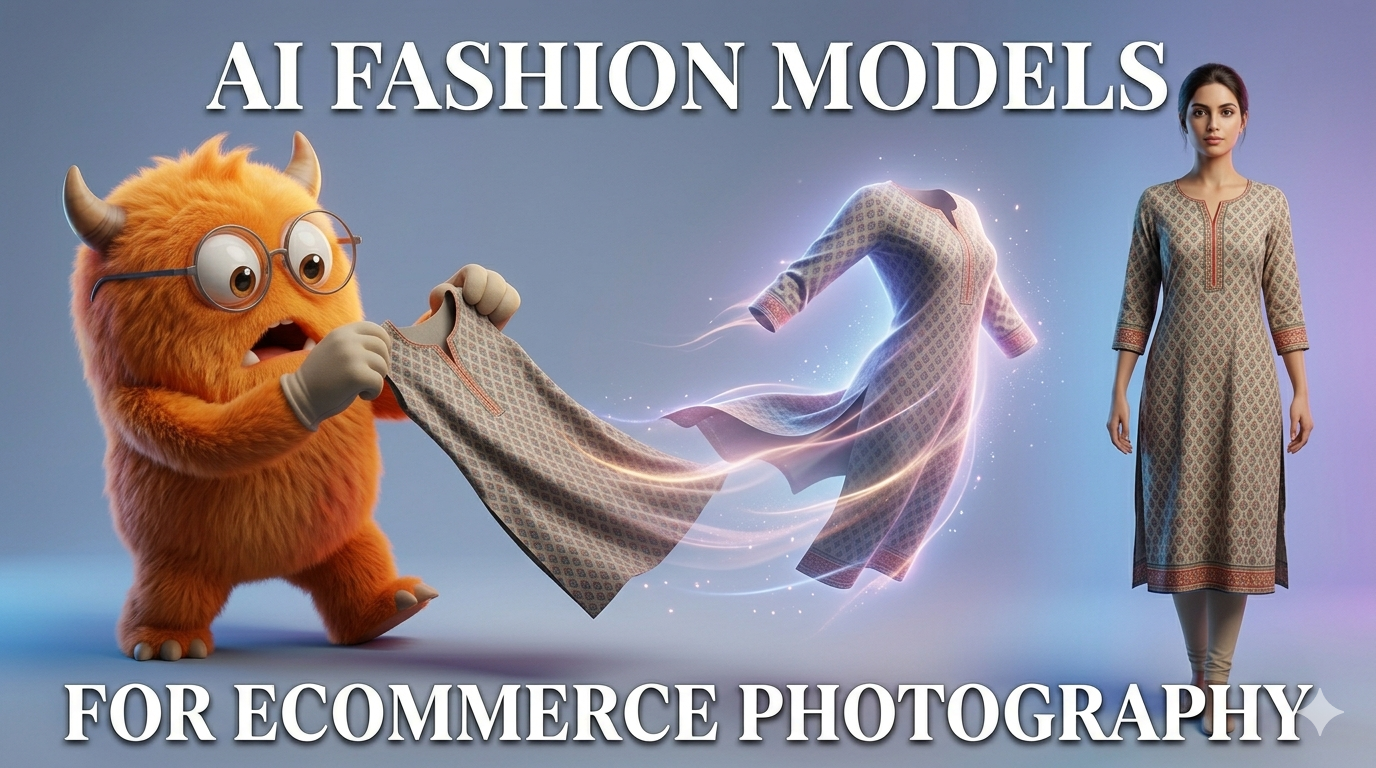
How AI Fashion Models Are Changing Ecommerce Photography (The Complete Picture)
| TL;DR An AI fashion model is a digitally created avatar that can be shown wearing your actual garment — generated from a flat-lay, hanger, or ghost mannequin photo. The technology works in two steps: the AI segments clothing pixels from the source image, then synthesises a human body and re-drapes the garment with realistic fabric physics. Ghost mannequin shots give AI better source material than flat-lays — the 3D volume and sleeve hang give the model more to work from. What AI handles well: catalog volume, size inclusivity, diverse representation, speed. What still needs human support: high-concept editorial campaigns, sheer or heavily layered fabrics, complex embroidery. Brands using AI fashion models include Etro (via Pixel Moda) and ASOS — both cited as early adopters at BoF VOICES 2025. EU AI Act Article 50 requires disclosure of AI-generated content for EU markets from August 2026. |
|---|
A few years ago, showing a garment on a model meant booking one. Studio time, casting, a stylist, a photographer, and weeks of post-production. That workflow hasn't disappeared — but it's no longer the only option. AI fashion models let brands take a flat-lay or ghost mannequin photo and generate a photorealistic image of a model wearing that exact garment, with the original fabric, print, and colour preserved. This guide explains what AI fashion models actually are, how the technology works, where it fits and where it doesn't, and what it means practically for Indian fashion brands selling on Myntra, Flipkart, and beyond.
What Is an AI Fashion Model?
An AI fashion model is a digitally created human avatar — not a stock photo, not a CGI character, and not a real person. It's a pixel-by-pixel synthetic human generated by a trained AI model, designed to look photorealistic when shown wearing real clothing.
Looklet describes them as 'digitally created avatars designed to look, pose, and move like a real model — featuring anatomically correct poses, consistent styling, realistic movement, and lifelike garment interaction.' The key distinction from traditional CGI or 3D fashion is that these avatars are generated by AI from your actual product images, not hand-modelled by a 3D artist.
- They are not based on real people — no image rights, no consent issues, no casting fees.
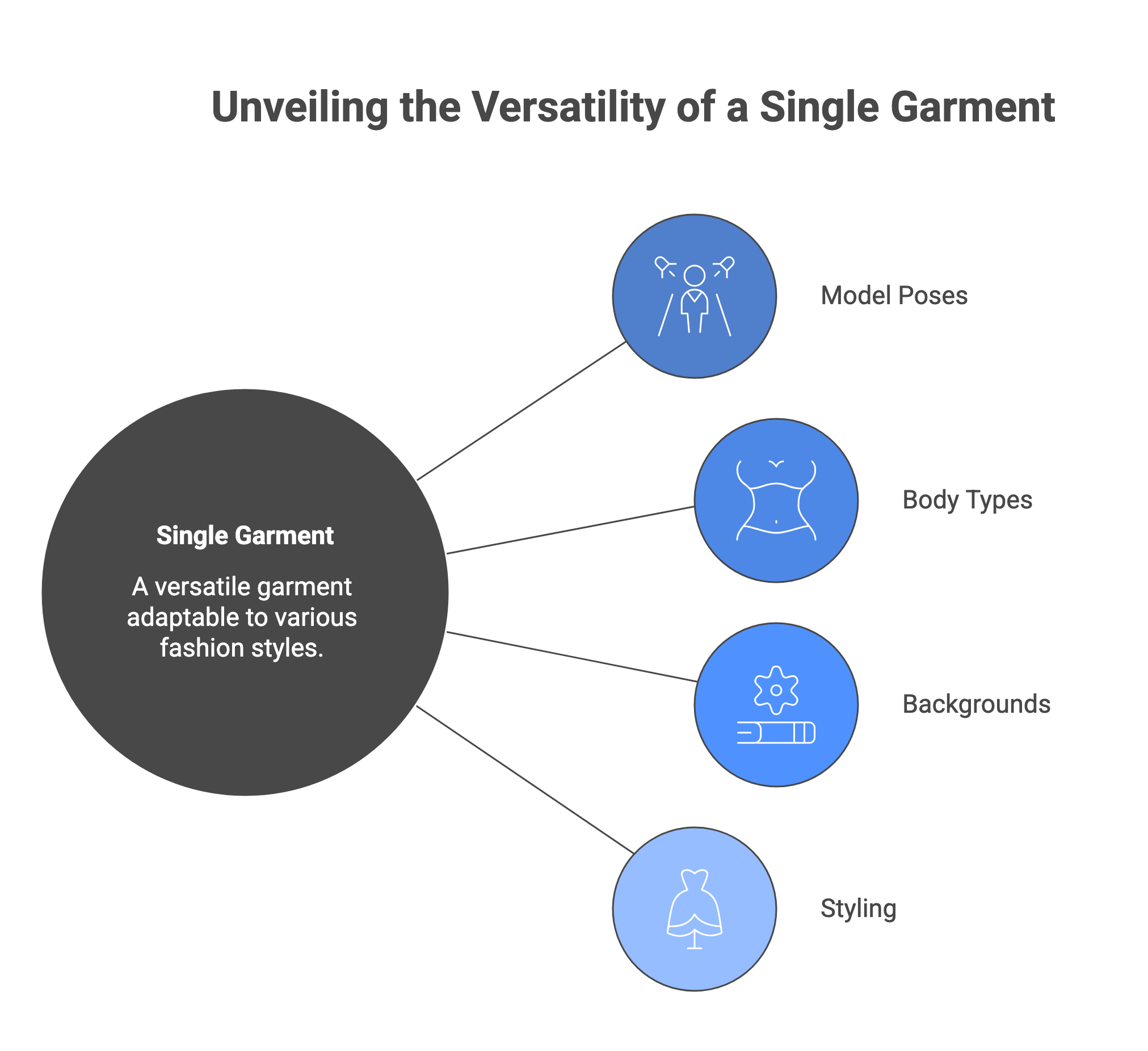
- They are controllable — age, ethnicity, body type, skin tone, and pose can all be specified.
- They are garment-accurate — the technology preserves the original product's textures, prints, and colour.
- They are scalable — the same workflow that produces one on-model image produces a thousand.
How the Technology Actually Works
Understanding the underlying process helps brands know what to expect — and why input quality matters so much.
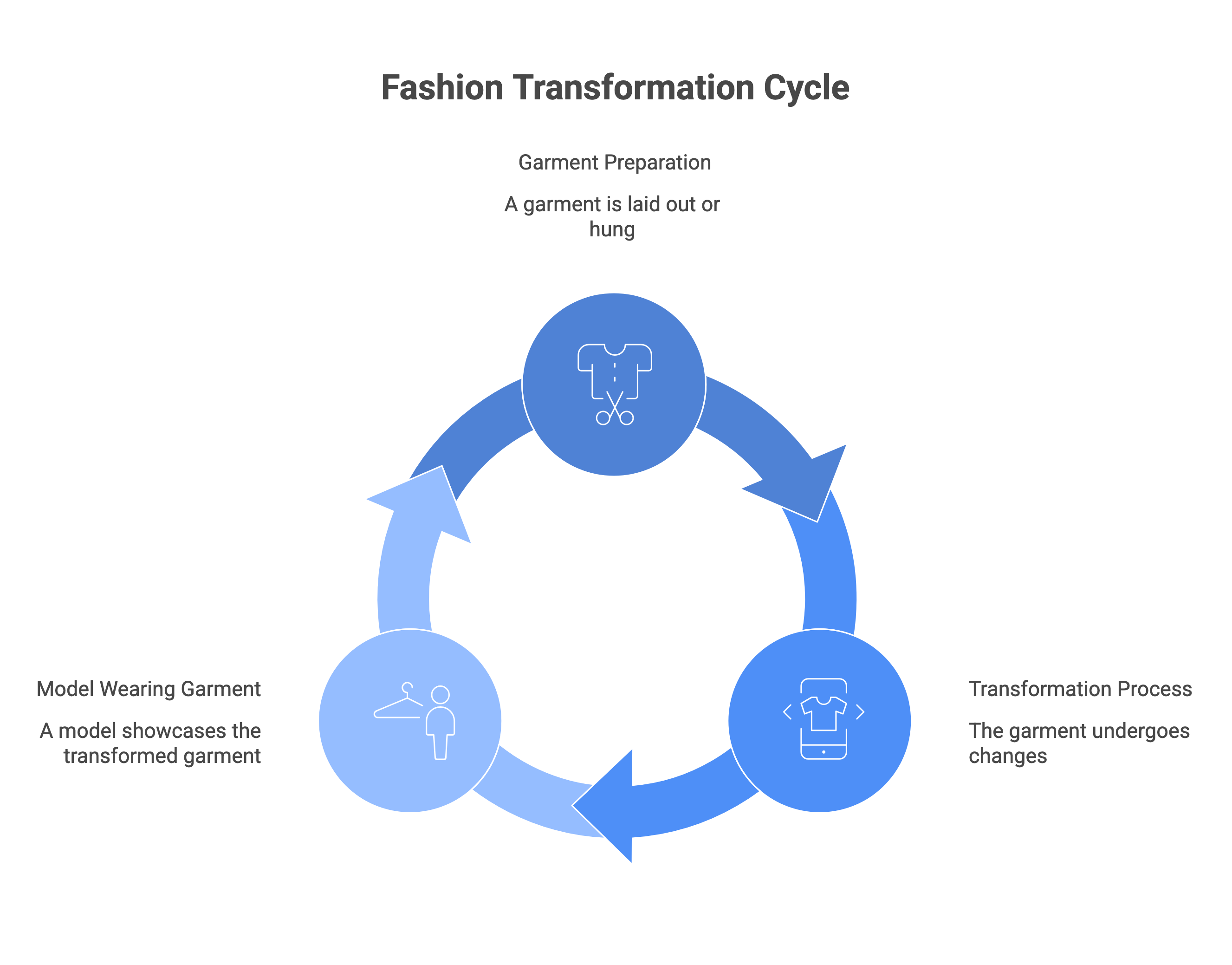
Step 1 — Segmentation
The AI scans the source image and identifies clothing pixels — separating them from the background. It recognises garment structure: 'this is a sleeve,' 'this is a collar,' 'this is a button placket.' This is computer vision work, powered by models trained on large datasets of labelled garment imagery.
Step 2 — Human Body Synthesis
Based on the model type selected (via prompt or catalogue), the AI generates a human body from scratch — a synthetic person who does not exist. Diffusion models and GANs (Generative Adversarial Networks) handle this generation step. The body is created to match the pose, proportions, and styling context the brand specifies.
Step 3 — Garment Draping
The AI maps the segmented garment pixels onto the generated body. It simulates fabric physics — how the material folds, hangs, stretches at the shoulder, or tapers at the waist. Lighting and shadow are generated to match the body and garment together into a coherent scene.
Why Ghost Mannequin Beats Flat-Lay as Source Material
A ghost mannequin shot preserves the garment's 3D volume — the sleeve hang, the neckline shape, the shoulder structure. A flat-lay collapses all of that into two dimensions. When the AI needs to re-drape a jacket onto a human body, it has far more structural information to work from in a ghost mannequin image than a flat-lay, which produces more realistic results.
What Brands Are Already Doing with AI Fashion Models
Adoption is real and accelerating. Two examples cited at BoF VOICES 2025 illustrate the direction:
| 🏷️ Levi Strauss & Co. Levi’s announced the use of AI-generated models to increase diversity in its ecommerce imagery. The goal is to showcase products on a wider range of body types, skin tones, and ages without the logistical complexity of traditional photoshoots. The brand clarified that AI would complement, not replace, human models and photography. |
|---|
| 🏷️ H&M H&M has experimented with AI across design and content workflows, including virtual models and digital twins for faster campaign production. AI is used to scale content creation while maintaining consistency across global markets. |
|---|
Both examples share a common pattern: AI is handling the volume and variation work — catalog shots, size options, diverse representation — while human photographers and creative directors focus on high-concept campaign work where nuance matters most.
The Practical Workflow: From Garment to On-Model
For fashion brands, the workflow is straightforward regardless of which tool is used:
- Photograph the garment — flat-lay, hanger shot, or ghost mannequin. Ghost mannequin produces the best AI results. The garment should be well-lit, wrinkle-free, and fully visible in frame.
- Upload to the AI tool — the platform's computer vision engine segments the clothing from the background.
- Select a model — age, ethnicity, body type, skin tone. Tools like Claid offer 100+ pre-built AI models; others allow custom model creation via prompt. Some tools let you lock a consistent model across an entire catalog for brand coherence.
- Set the pose and background — studio white for marketplace compliance, lifestyle setting for social and editorial, or custom prompt for specific campaign aesthetics.
- Generate and review — AI produces the on-model image. Review for garment accuracy: check that prints, logos, seams, and fabric texture match the source.
- Export — in the correct resolution and format for the target platform. Myntra, Amazon India, and Flipkart all have different image specifications.
| ✦ Generate AI Fashion Model Images with Scalio — Try Free → ✦ try for free · Myntra-ready framing · Indian poses · No card required |
|---|
Where AI Fashion Models Work Well
| Use Case | Why AI Excels |
|---|---|
| Catalog volume production | Same source image → multiple model types, poses, and backgrounds. What takes days in a traditional shoot takes hours with AI. |
| Size inclusivity | Generate the same garment on diverse body types — plus-size, petite, athletic — without separate model bookings or shoot days. |
| Demographic representation | Specify ethnicity, skin tone, and age range for each model. Reach different customer segments with targeted imagery from one source photo. |
| Seasonal and festival variations | Swap backgrounds and styling contexts quickly — Diwali campaign to summer lifestyle without a reshoot. |
| Pre-production visualisation | Generate on-model images before physical samples are produced — useful for design review and early-stage marketing. |
| Marketplace compliance | AI tools output images to exact platform specifications — Myntra on-model framing, Amazon white-background, Flipkart dimensions. |
Where AI Fashion Models Still Have Limits
Current technology is strong but not universal. These are the areas where human photographers still hold an edge:
| Current Limitations — Be Honest with Buyers and Your Team Sheer and heavily layered fabrics — transparent materials, chiffon layers, and multi-piece sets are difficult for AI to drape convincingly. The geometry of 'what goes over what' is still not reliably handled. Complex embroidery and intricate surface detail — fine handwork like zari, mirror work, and delicate embellishments can blur or lose precision in AI-generated output. Extreme or highly dynamic poses — action shots, jumping, and dramatic editorial poses may show anatomical inconsistencies. High-concept emotional storytelling — the spontaneous, human quality of a great editorial image — a glance, a laugh, a specific moment — cannot be generated from a product photo. Brand-defining campaign imagery — flagship seasonal campaigns and hero images for premium brands generally still benefit from human photography. |
|---|
AI Models vs Ghost Mannequin vs Flat-Lay: When to Use Which
| Format | Best Used For | Indian Marketplace Fit |
|---|---|---|
| Flat-lay | Kids' and baby clothing (Amazon/Flipkart requirement), accessories, multi-pack items where model is not appropriate. | Amazon India — kids/baby: required. Accessories: required. |
| Ghost mannequin | Structured outerwear, tailored pieces where fit and shape matters more than lifestyle context. Also the best source image for AI processing. | Flipkart structured categories. Good source for all AI workflows. |
| AI on-model | Adult apparel — dresses, tops, trousers, kurtis, ethnic wear. Required for Myntra. Strong for Flipkart fashion and Amazon fashion categories. | Myntra: required. Amazon India fashion: strongly preferred. |
| AI lifestyle (model + background) | D2C Shopify, Instagram ads, Nykaa Fashion, festival campaign creatives. | Shopify, Nykaa Fashion, social advertising. |
🔗 Flat Lay vs On-Model — Which Gets More Clicks →
Ethics, Transparency, and What to Know About Disclosure
AI fashion models raise real questions — about the representation of real bodies, about transparency with shoppers, and about regulatory compliance. These are worth addressing clearly rather than glossing over.
Representation
Early AI model tools exhibited bias because they were trained on datasets that reflected fashion photography's historical lack of diversity. Current tools allow explicit control over body type, ethnicity, age, and skin tone — but the responsibility for inclusive representation sits with the brand, not the tool. Choosing to generate only one body type or skin tone is still a choice, even when the technology makes diversity easy.
Accuracy Over Aspiration
AI models should represent how a garment actually fits and drapes — not an edited, idealised version. Brands that use AI to make garments appear slimmer, smoother, or differently proportioned than reality face increased returns and eroded customer trust. The standard should be: does this image accurately represent what a customer will receive?
What This Means Specifically for Indian Fashion Brands
- Myntra compliance is no longer a shoot-budget problem — Myntra requires on-model images for most adult apparel categories. AI fashion models make this mandatory requirement accessible to brands at any scale, not just those with large photography budgets.
- Seasonal velocity — India's fashion calendar moves fast: Eid, Navratri, Diwali, wedding season, summer. AI models let brands generate fresh on-model campaign imagery for each season in days, not weeks.
- Multi-platform from one source — one garment photo → Myntra-compliant on-model → Amazon India white-background → Nykaa Fashion lifestyle → Shopify editorial → Instagram ad variant. All from the same shoot.
- Regional diversity — AI models allow brands to represent customers across India's diverse skin tones, body types, and regional aesthetics without the logistical complexity of large multi-model shoots.
- The plus-size gap — India's plus-size apparel segment is growing, and most brands struggle to represent it photographically. AI makes diverse size representation a workflow decision, not a budget decision.
🔗 How AI Fashion Models Reduce Time to Market →
Frequently Asked Questions
What is an AI fashion model and how is it different from a real model photo?
An AI fashion model is a fully synthetic human figure generated by AI, not a real person, not a stock photo. It's created pixel-by-pixel to show your actual garment on a realistic human body. The garment comes from your product photo (flat-lay or ghost mannequin); the human body and surrounding context are AI-generated. The result looks like a professional model photo, but no model was ever present.
Does the AI preserve the exact print, colour, and texture of my garment?
Yes, for most structured garments — provided the source image is well-lit, high-resolution, and shows the full garment without heavy distortion. Purpose-built ecommerce AI tools are specifically trained to anchor the garment pixels and only change the surrounding context (model, pose, background). Generic image generators do not offer this guarantee and should not be used for product listings.
Does Myntra accept AI-generated on-model images?
Myntra requires on-model images for most adult apparel categories — the platform's guidelines specify the image must show the garment on a standing human model. AI-generated on-model images meet this requirement, provided they accurately represent the garment and follow Myntra's framing and image quality specifications. Scalio's Model Studio is designed to produce Myntra-compliant on-model outputs.
Can I use the same AI model across my entire catalog for brand consistency?
Yes. Most professional tools allow you to save a model configuration — appearance, pose style, background aesthetic — and apply it consistently across every garment in a collection. This produces a coherent brand look across a catalog, which is something traditional model shoots struggle to maintain when bookings span multiple shoot days with different lighting conditions.
Are there legal concerns with using AI fashion models in India?
No specific AI laws yet. AI models avoid consent issues, but images must not be misleading and must follow advertising rules. EU exports may require AI disclosure from August 2026.
What type of garment does AI struggle with most?
Sheer fabrics, heavily layered pieces, and garments with complex surface embellishment, intricate embroidery, mirror work, heavy zari, are the categories where AI output is least reliable. For these, a hybrid approach works best: use AI for white-background catalog shots and lifestyle backgrounds, but shoot the garment on a real model for the hero on-model image. For structured, solid-colour, or simple-print garments, AI performs well across the board.
| ✦ Try Scalio's Model Studio — On-Model Images for Myntra, Amazon & More → ✦ try for free · Indian poses · Diverse models · No card required |
|---|