
Most "Scalio vs X" comparisons are a bit dishonest, because they line up two tools that were never trying to do the same job and then declare a winner. This one is different, and it is worth saying up front: HookAds AI and Scalio solve two different halves of the same problem.
HookAds tells you what ad to make. Scalio makes it. If you have been trying to figure out which one to pay for, the honest answer for most D2C brands is that they sit at different points in the same workflow, and knowing which half you are actually stuck on is the whole decision.
TL;DR
- HookAds AI is a creative-intelligence library. 1,750+ AI ad prompts, 118 hook frameworks with 354 written examples, ad teardowns, case studies, and 27 free generator tools. The library is free to browse with no signup wall.
- Scalio is a production tool. You upload one product photo, add brand context, and it generates model-wearing Reels, AI product photoshoots, social posts, and a content calendar with your actual product in them.
- HookAds is where you find the angle. Scalio is where the asset gets made.
- They are not really substitutes. The realistic setup for a small D2C team is HookAds for the hook and Scalio for the output.
- Pick HookAds first if your ads look fine but nobody stops scrolling. Pick Scalio first if you know exactly what to post and have no photos to post it with.
Key definition: An ad creative library gives you the ideas, prompts, and frameworks behind ads that already worked, and you supply the production. An AI ad generator takes your product and produces the finished image or video directly. HookAds AI is the first kind. Scalio is the second.
What HookAds AI actually is
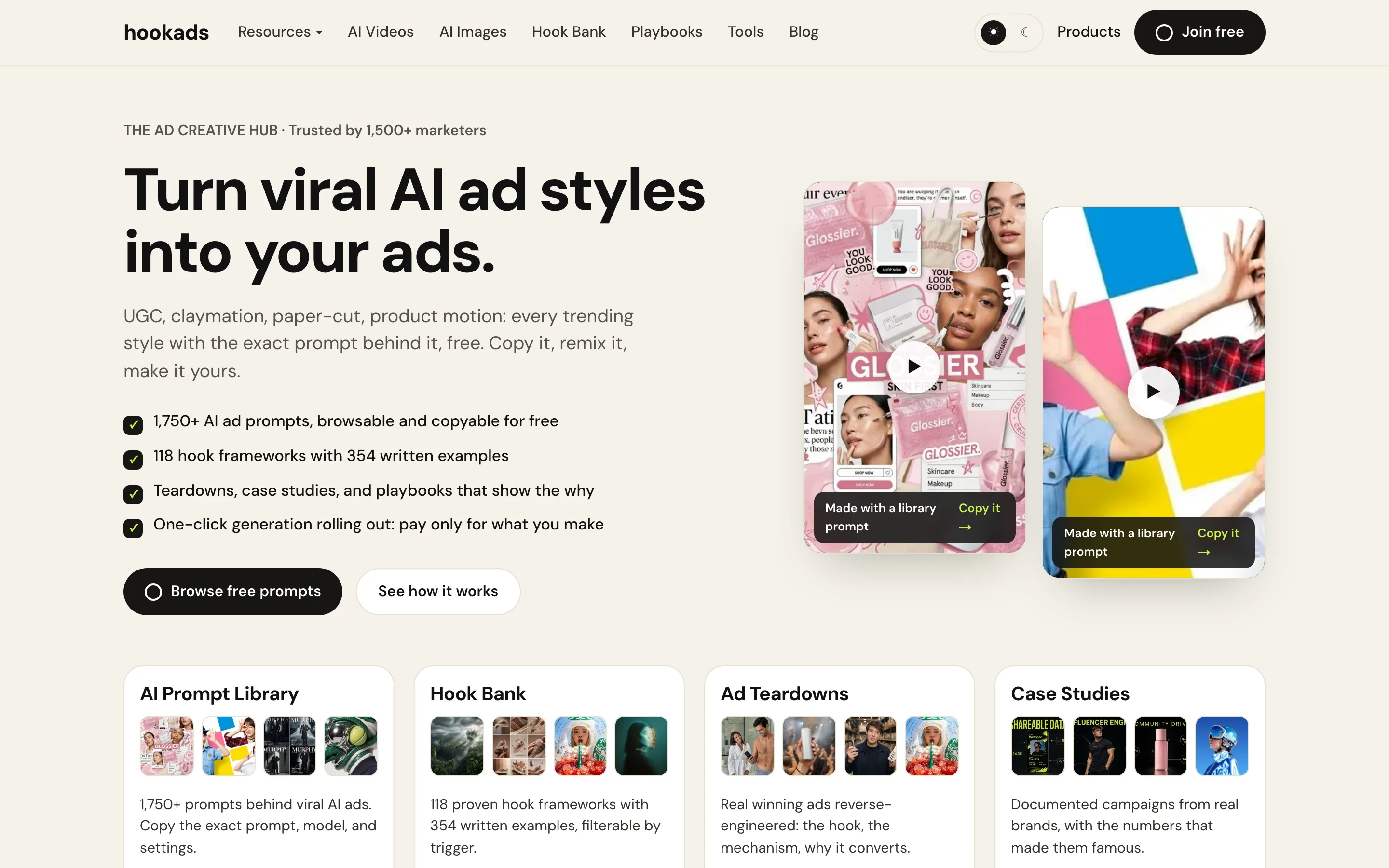
HookAds AI positions itself as "the ad creative hub," and that description is accurate. It is built by a performance marketer, and it is trusted by 1,500+ marketers according to its own site.
What you get:
- AI Prompt Library: 1,750+ prompts behind viral AI ads, each shipping with the model, settings, and source, so you can paste it straight into whatever AI tool you already use
- Hook Bank: 118 proven hook frameworks with 354 written examples, filterable by psychological trigger
- Ad Teardowns: real winning ads reverse-engineered, covering the hook, the mechanism, and why it converts
- Case Studies and Playbooks: documented campaigns with the numbers, plus multi-chapter execution plans
- Trend Radar: what is scaling right now, refreshed for the week
- 27 free AI tools: hook generators, ad copy, UGC scripts, headline and CTA generators
- The Hook: a free weekly newsletter that tears apart one real ad every Tuesday
The pricing model is genuinely friendly. The whole library is free forever with no signup wall, and you only pay for the compiled playbooks: the Mobile App Ads Playbook at $99 one-time, the Meme Ads Playbook at $49, and the AI Ad-Making Kit at $99. One-click generation is listed as rolling out soon, where you would pay only for what you generate.
The important bit for this comparison: today, HookAds gives you the prompt. You still bring your own AI tool, your own product photos, and your own production time to turn that prompt into a finished ad.
What Scalio actually is
Scalio is an AI marketing app built for Indian SMBs. You give it a product photo plus some brand context, and it generates the finished asset: model-wearing Reels, AI product photoshoots, social posts, and a full content calendar.
The core difference is that your actual product is inside the output. A saree seller in Surat uploads one flat-lay shot of a saree and gets back a model wearing that exact saree, in a Reel, ready for Instagram or a Myntra listing. There is no studio booking, no model, no photographer, and no reshoot when the next collection lands.
Scalio runs on iOS, Android, and web, is used by 100K+ Indian businesses, and holds a 4.8 rating. Pricing starts at ₹999/month for 100 credits, with ₹1,999/month for 250 credits, positioned against the ₹10,000 to ₹50,000 per month an agency retainer costs in India.
Scalio vs HookAds AI: the quick comparison
| Scalio | HookAds AI | |
|---|---|---|
| Core job | Generates the finished ad creative | Supplies hooks, prompts, and frameworks |
| Your product in the output | Yes, from your uploaded photo | No, you produce it yourself |
| Output types | Model-wearing Reels, product photoshoots, social posts, content calendar | Prompts, hook frameworks, teardowns, playbooks, copy from free tools |
| Video generation | Yes | Not yet, one-click generation listed as rolling out |
| Learning material | Product-focused | Extensive: teardowns, case studies, playbooks, glossary, weekly newsletter |
| Free tier | Trial credits | Entire library free forever, no signup wall |
| Paid model | ₹999/month (100 credits), ₹1,999/month (250 credits) | One-time playbooks: $49 to $99 |
| Built for | Indian SMBs, D2C sellers, marketplace sellers | Performance marketers and ad creative teams globally |
| You still need | An angle worth posting | A tool to actually produce the creative |
Where HookAds AI fits best
Pick HookAds AI first if your problem is strategy, not production.
You already have decent product photos. You can shoot a Reel on your phone. But your ads plateau because every one of them opens the same way, and you have no idea which hook to test next. That is exactly what the Hook Bank and the teardowns solve. 118 frameworks with 354 written examples is a bigger swipe file than most D2C teams will get through in a year.
It also fits if you are a marketer who enjoys the craft. The playbooks and case studies are genuinely educational, and the free weekly teardown newsletter is a low-effort way to keep improving without paying for anything.
Where Scalio fits best
Pick Scalio first if your problem is production, not ideas.
This is the more common situation for a small Indian D2C brand or a marketplace seller. You know you should be posting Reels. You know festive season needs fresh creative. The blocker is that a photoshoot costs ₹15,000, the model is booked out, and you have 60 SKUs to shoot before Diwali. No amount of hook frameworks fixes that, because the bottleneck is the camera, not the copy.
Scalio removes that specific blocker. One product photo becomes a model-wearing shot, a Reel, and a week of posts. For a boutique in Jaipur or a seller listing on Meesho and Flipkart, that is the difference between posting weekly and posting never.
Key insight: Hooks do not fix an empty content folder, and beautiful creative does not fix a boring angle. Diagnose which one is actually stopping you before you pay for either, because paying for the wrong half changes nothing.
The honest answer: use both
For most D2C teams the realistic workflow is not either/or:
- Find the angle on HookAds. Browse the Hook Bank, pick a framework that fits your product and audience, and read a teardown or two to understand why it works.
- Produce it in Scalio. Upload the product photo, generate the model-wearing shots or Reels that execute that angle with your actual product.
- Schedule it. Drop the output into a social media calendar so it goes out consistently instead of whenever someone remembers.
HookAds costs nothing to browse, so there is no real reason not to use it for the strategy layer. Scalio's ₹999/month handles the production layer. Together that is well under what a single agency month costs in India, and considerably less than one physical photoshoot.
What that looks like in practice
Take a saree seller in Surat launching a festive collection. The old version of this week is: book a studio, book a model, wait for dates, shoot 20 sarees, wait for edits, then post whatever survives the deadline.
The workflow version looks like this. Monday, they open the Hook Bank and pick a framework, say a before-and-after angle, because the teardowns show it performing for apparel. Tuesday, they upload flat-lay photos of eight sarees to Scalio and generate model-wearing shots and a Reel for each. Wednesday, those go into the calendar, spaced across the next two weeks, with captions drafted from the hook they picked on Monday.
No studio, no model booking, and the creative direction came from ads that already worked instead of a guess. That is the actual argument for treating these two as a pair rather than a choice.
Which one should you actually pay for?
Ask yourself one question: if a perfect ad script landed in your inbox right now, could you produce it by tomorrow?
- No, I have no photos or video to work with. Start with Scalio. Your bottleneck is production. Browse HookAds free alongside it.
- Yes, I can shoot it, I just do not know what to shoot. Start with HookAds. Your bottleneck is the angle, and the library is free, so start there before spending anything.
- Both, honestly. Start with the free HookAds library this week, and add Scalio when you hit the "I have the idea but no assets" wall, which usually happens in week two.
If you are still mapping the wider landscape, our roundup of AI marketing tools puts both of these in context alongside the rest of the stack, and our guide to AI for social media covers the posting cadence side.
Frequently Asked Questions
Is HookAds AI free?
The library is free forever with no signup wall, including 1,750+ prompts, 118 hook frameworks, teardowns, case studies, and 27 free generator tools. You only pay for the compiled playbooks, which are one-time purchases between $49 and $99, and for one-click generation once it rolls out.
Does HookAds AI generate the ad for me?
Not currently. HookAds gives you the exact prompt, model, and settings, and you paste that into your own AI tool to produce the creative. Its site lists one-click generation as rolling out soon, where you would pay only for what you generate.
Can Scalio replace an ad agency?
For creative production, largely yes. Scalio generates model-wearing photos, Reels, and social posts from a product photo, which is the bulk of what an Indian agency retainer of ₹10,000 to ₹50,000 a month covers. Strategy, media buying, and campaign management still need a human, whether that is you or an agency.
Which is better for a small Indian D2C brand?
They answer different questions. If you cannot produce creative at all, Scalio solves the blocker at ₹999/month. If you can produce creative but it is not converting, HookAds' free library solves the blocker for nothing. Most brands end up using the free HookAds library for angles and Scalio for output.
Do I need both tools from day one?
No. Start with whichever half is actually stuck. Since the HookAds library is free to browse, the practical order for most teams is to start reading it immediately and add a production tool like Scalio when you run out of assets to execute the ideas with.