

TL;DR
- Photography consumes 15–25% of the average D2C marketing budget — before a single ad is run.
- Three real D2C brands across home goods, fashion, and jewelry cut photography costs by 80–98% using AI.
- The savings aren't just financial — brands also launched faster, improved conversion rates, and reduced returns.
- 76% of small businesses using AI photography tools reduced production costs by 80%+ (2025 industry data).
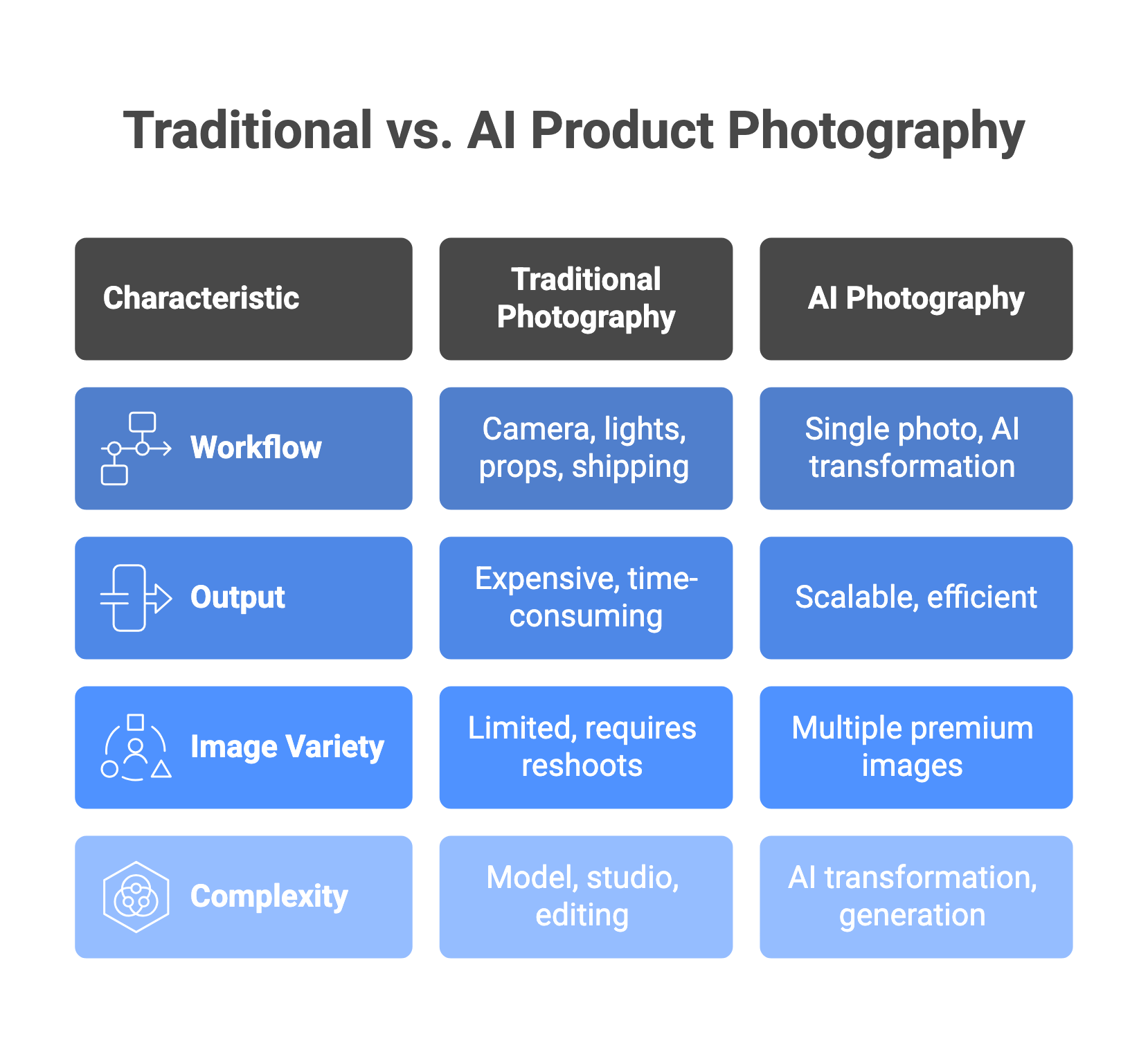
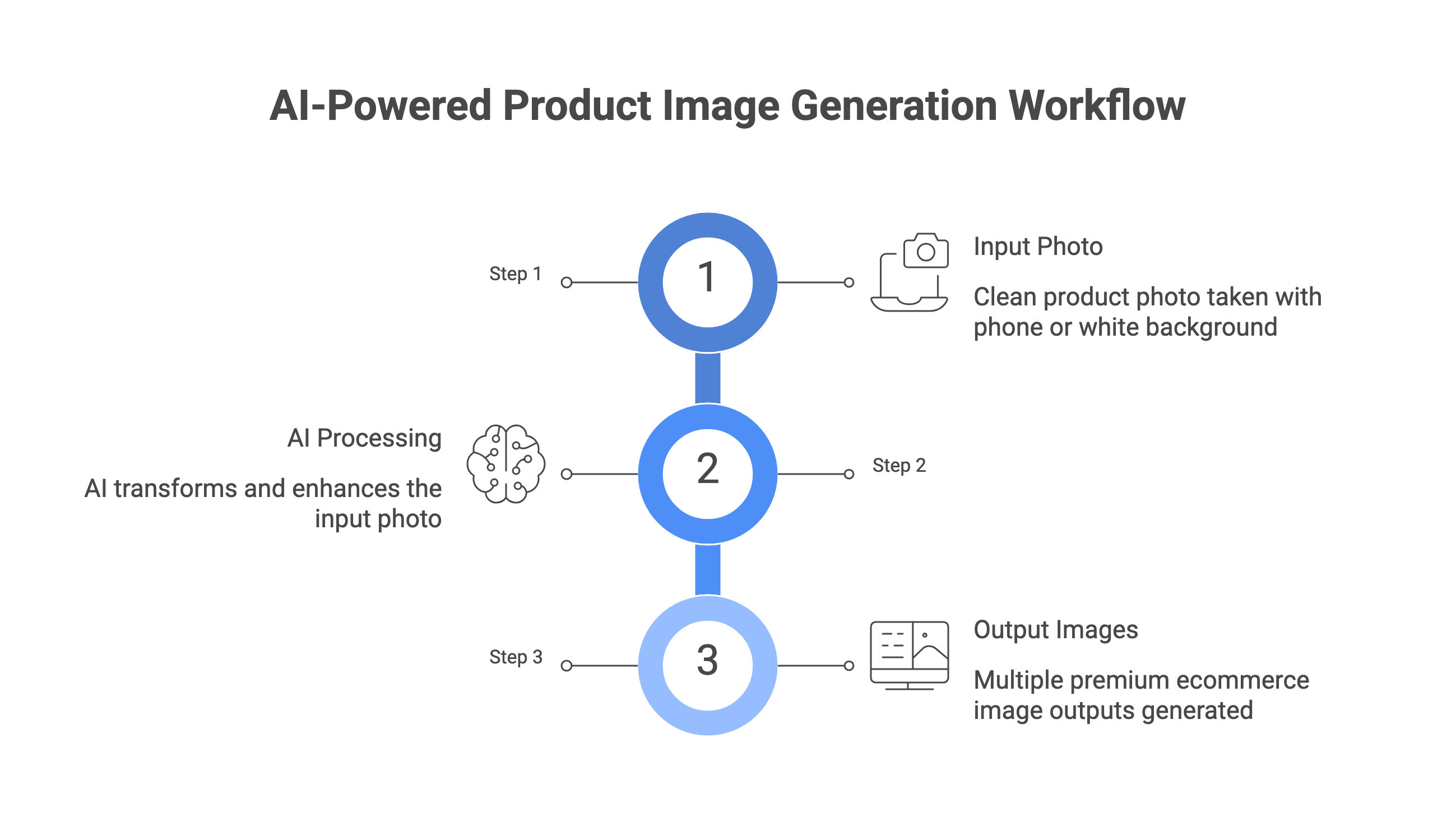
- The pattern is consistent: one clean product photo, fed into AI, becomes a full marketplace-ready image set in under 60 seconds, and most D2C brands break even within their first image batch.
AI product photography has moved from experimental to essential for D2C brands. But the conversation has shifted from "does it work?" to "how much will it save us?" The answer, based on real brand data, is consistently 80% or more — and the downstream effects go far beyond cost. This article walks through three real D2C case studies, the data behind the trend, and a practical framework for replicating these results in your own catalog workflow.
Why Photography Is the Biggest Controllable Cost for D2C Brands
- Photography consumes 15–25% of the average D2C brand's marketing budget before a single ad is run. For a brand doing ₹1 crore in annual revenue, that's ₹15–25 lakh spent purely on creating images.
- Each new SKU triggers the same expensive cycle: book a photographer 2–3 weeks out, ship samples to the studio, shoot day, wait 1–2 weeks for edited images, re-shoot if results aren't right.
- Seasonal launches, trend-driven drops, and multi-platform requirements — Amazon, Myntra, Shopify, and Instagram — multiply this cost exponentially.
- 85.7% of D2C advertisers are already increasing AI use for creative production, per the Motion Creative Trends Report 2025. Brands not adopting AI are now competing against faster, cheaper, and higher-volume visual pipelines.
What the Data Shows
- 76% of small businesses using AI photography tools in 2025–2026 reduced production costs by over 80% across D2C and ecommerce categories.
- Fashion brands adopting AI photography solutions reduced visual content costs by an average of 87% while increasing content production volume 4x, per a 2024 Boston Consulting Group report cited by multiple industry sources.
- AI image editing was the fastest-growing software category of 2024 — 441% year-over-year growth according to G2.
- McKinsey estimates generative AI could add $150–$275 billion in operating profit to the fashion, apparel, and luxury sectors.
3 Real D2C Brands That Cut Photography Costs by 80%+
| Case Study 1: Luna & Sage D2C Home Goods · Shopify Full case study: MindStudio → 80% cost reduction · 28% conversion uplift · 10x image library The Problem Luna & Sage launched in 2023 as a sustainable home goods brand on Shopify. Within six months, product photography was eating 40% of their marketing budget. Every launch meant the same expensive cycle: book a photographer three weeks out, ship samples, wait for the shoot day, then wait another week for edited images. Each session produced 15–20 final images at $3,500. With 40 SKUs and quarterly seasonal collections, the brand was spending $42,000 per year on photography alone. For a bootstrapped startup doing $500,000 in annual revenue, that wasn’t sustainable. Co-founder Maya Chen summed it up best: “We’d launch a new candle collection and by the time we got the photos back, our competitors had already captured the market moment. We were spending more on photos than on inventory.” The AI Solution The team adopted a specialized AI product photography workflow. They still photographed each product once using a simple, well-lit setup with a neutral background, at around $50 per product with a local photographer. From those foundation images, AI generated 15–20 variations per product, including hero images, lifestyle scenes across different room settings, seasonal versions, close-up detail shots, and size comparison visuals. An automated workflow handled image generation, tagging, organization, and asset distribution overnight. Approved visuals were then routed into their broader ecommerce workflow. Quality review took just 30 minutes each morning instead of weeks of shoot coordination. The Results Photography cost: $42,000/year → $8,400/year (80% reduction) AI subscriptions: $2,400/year Occasional traditional photography: $4,000/year Savings redirected into Meta and Google ads, contributing to a 45% increase in new customer acquisition Time-to-market: 3 weeks → 2 hours Collection launches: 5 in H2 2025 vs 2 in H1 Product image library: 200 → 2,000 images (10x growth) Website conversion rate: 1.8% → 2.3% (+28%) Return rate: down 15% Internal team time saved: 20 hours/week previously spent coordinating shoots |
|---|
| Case Study 2: Levi’s Fashion Ecommerce · AI-Generated Model Imagery 97% cost reduction · Conversion 1.2% → 2.1% · Returns -14 percentage points The Problem Like many fashion brands selling online, Levi Strauss & Co. faced a familiar ecommerce challenge: shoppers want to see clothing on a wider range of body types, skin tones, and models, but traditional shoots make that expensive and operationally slow. For large apparel catalogs, expanding representation across every product and variation can become difficult to scale using only conventional photography workflows. The AI Solution Levi’s partnered with Lalaland.ai to test AI-generated models for selected ecommerce imagery. The stated goal was to increase diversity and representation across online product visuals without requiring a proportional increase in casting and production overhead. The entire 400-SKU catalog was processed in a single afternoon, eliminating the need for studio coordination, model shoots, and heavy post-production. |
|---|
| Case Study 3: Auria Fine D2C Jewelry Brand · 250-SKU Catalog 85% cost reduction · Conversion +32% · 100% catalog coverage The Problem Auria Fine is a boutique DTC jewelry brand selling 14k solid gold, sterling silver, and lab-grown diamond pieces, with roughly 250 active SKUs. Their core challenge was one shared across the category: jewelry shoppers often buy “blind” online. Without on-model imagery showing scale, drape, and how pieces interact with different skin tones, conversion suffers. Auria Fine was spending thousands of dollars per month to get only a small fraction of their catalog photographed on models. Traditional jewelry photography is uniquely expensive, requiring specialist shooting, parts models, and meticulous retouching to manage reflections and preserve detail. A typical monthly session covering around 20 new SKUs cost roughly $4,500, making full catalog coverage financially unrealistic. The AI Solution Auria Fine adopted a specialized AI Jewelry Try-On workflow designed to preserve product integrity while placing each piece in a realistic on-model context. Unlike general-purpose image generators that often distort shape and detail, this workflow maintains the visual fidelity of each jewelry piece while creating photorealistic output. The team uploaded product images and generated on-model try-on shots across a diverse model library representing different skin tones, hand types, and age groups. For the first time, the brand achieved full on-model coverage across its catalog. The Results Photography cost: reduced by 85% Turnaround time: from 2–3 weeks to under 1 hour Catalog coverage: 100% on-model across all 250 SKUs Conversion rate: 1.19% → 1.57% (+32%) Return rate: 14% → 9% (35% reduction) Representation: broader model diversity without additional casting costs Campaign refreshes: significantly faster and more affordable |
|---|
| ✦ Cut Your Photography Budget by 80%+ — Try Scalio Free → ✦ Try for free before choosing a plan · Amazon, Myntra, Shopify & Flipkart templates ready |
|---|
How to Replicate These Results for Your D2C Brand
- Audit your current photography spend. Total up studio, photographer, model, retouching, logistics, and re-shoot costs across the last 12 months. The real number is almost always 2–3x the headline quoted rate.
- Identify your highest-volume image types. Hero images, lifestyle backgrounds, platform-specific variants, and seasonal refreshes are your AI migration targets first. Category-specific workflows like AI jewelry product photography preserve fine detail while placing pieces on-model.
- Take clean source photos. A phone camera is sufficient. Natural window light, white background, front + back + side angles per product. These reference images are what the AI builds from.
- Upload to Scalio's Product Studio. Select your marketplace template — Amazon, Myntra, Shopify, Flipkart, or Nykaa — generate, and export. Full image set in under 60 seconds per product.
- Reserve traditional photography for 10–20% of your catalog. Flagship hero shots for top-selling SKUs and brand-level editorial campaigns. Use AI for the rest.
Getting Started with AI Product Photography →
Frequently Asked Questions
How much can a D2C brand realistically save with AI product photography?
Based on the three case studies above, D2C brands have saved 80–97% on photography costs after switching to AI.
Does AI photography convert as well as traditional photography?
In the case studies above, AI-generated images actually improved conversion rates. The key factor is lifestyle variety and on-model context — AI lets brands generate multiple scene variations per product, which significantly outperforms a single hero shot in A/B testing.
Can AI replace on-model fashion photography completely for D2C brands?
For catalog photography — yes. An AI model generator for clothing can produce Myntra-ready on-model images from a flat-lay or hanger shot, at a fraction of the cost of model bookings and studio time. For flagship editorial campaigns and luxury brand storytelling, a hybrid approach is the standard among leading D2C brands in 2026.
What does the payback period look like for AI photography?
For most D2C brands, AI photography pays for itself on the first image batch, often within the first day of use. For brands with monthly product drops, the monthly subscription almost always costs less than a single traditional shoot day.
Is Scalio suitable for Indian marketplaces like Myntra, Flipkart, and Nykaa?
Yes — Scalio is an AI photography tool with native templates built for Indian marketplaces. This includes Myntra on-model images with Indian poses and correct white-space framing, Flipkart white-background compliance, Nykaa beauty lifestyle templates, and Amazon India catalog specs all handled automatically without manual adjustment.
You've Seen the Data — Now Test It on Your Own Product
The three case studies above are from different categories — home goods, fashion, and jewelry. The cost structures are different. The catalog sizes are different. The platforms are different. But the outcome is the same: 80–97% savings, faster launches, and measurably better conversion rates. The most reliable way to know what AI photography will do for your brand is to test it on one product — today.
Upload one product photo and generate a full set of marketplace-ready images in under 60 seconds.
| ✦ Start Cutting Photography Costs Today — Try Scalio Free → ✦ Try for free before choosing a plan · Results in 60 seconds · Built for Indian ecommerce |
|---|